30% Dandelion

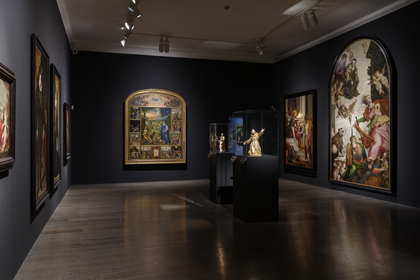
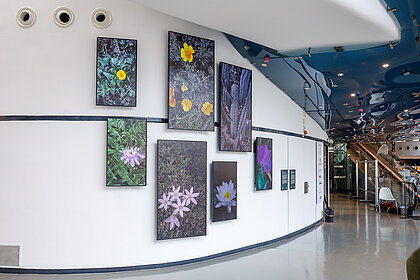
The exhibition focuses on the dandelion as a botanical, cultural, and aesthetic phenomenon. More than 35 works explore this resilient plant—and its surprising close connection to humans, with whom it shares about 30% of its genetic material.

Through poetic, political, and ecological perspectives, the works address themes such as adaptation, resistance, symbiotic cooperation, and recurring return. Selected loans from the collections of the Universalmuseum Joanneum further complement the exhibition.

Image Credits

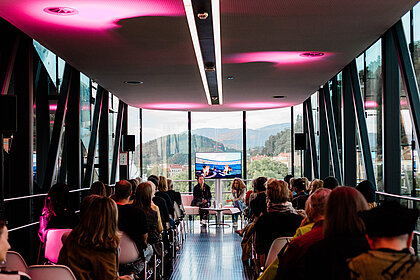
Why an exhibition about the voice is important

In a world full of crises, wars and dwindling freedom of expression, silence is spreading while a constant noise of information drowns out real communication. This leads to powerlessness and loss of control.

It is no longer enough to simply realise that our voices are often controlled by others - it is time to act, even if it is only by shouting or mumbling.


Works in the Exhibition

Image Credits

Iris Andraschek

Alles, was sich mischt, findet immer an Grenzen statt/Vsaka mešanica je na robu meje, 2023/2026

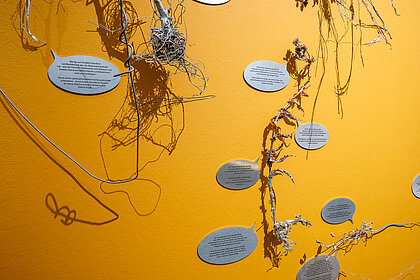
In her work, Iris Andraschek takes plants that she discovered and galvanised on the Pečnik meadow in the Austrian-Slovenian border area near Eisenkappel/Železna Kapla and combines these with quotes from conversations she had with i. a. the local population. Current problems facing the alpine landscape are mixed with memories of the local Slovenian resistance against the Nazi regime. After the end of World War II, this was a central argument for Austria’s independence and the legal equality of linguistic minorities. In speech bubbles, Andraschek gives a voice to witnesses of historical and current resistance. Meadow plants act as regional commentators, highlighting ecological, political and social references.
Credits

Image Credits

Suzanne Anker

When Crystals Spawn Flowers, 2024

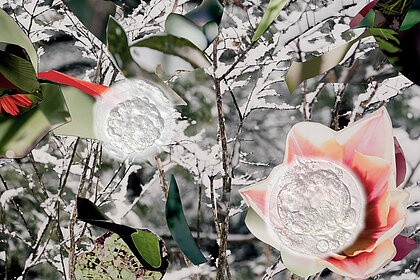
When Crystals Spawn Flowers are 3D prints created at the Montefiore Institute for Reproductive Medicine and Health, where Anker explored oncofertility (the preservation of fertility in cancer patients) and artificially assisted reproduction. Anker uses the process of in vitro fertilisation as a metaphor for reawakening after frost: crystalline forms refer to the freezing of individual egg cells, sperm or embryos, which ‘hibernate’ like plants and are brought back to life when needed. Their thawing and insertion resembles a natural growth cycle, but at the same time raises ethical questions about genetics and a market-driven extension of fertility, especially in the context of a flourishing market for IVF banks.


More of Suzanne Anker in Analytical Beauty, Neue Galerie Graz, 24.04.–04.10.2026

Image Credits

Karl Blossfeldt

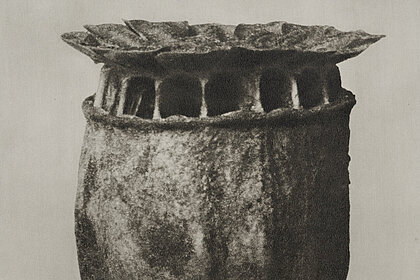
From the series Urformen der Kunst: Schachtelhalm, 1928; Mohnkapsel, 1928; Skabiose, 1928; Weberdistel, 1928

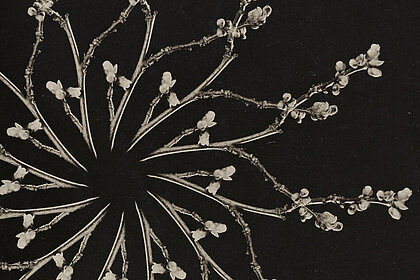
Karl Blossfeldt is considered one of the central figures in photography. His work combined art and science in a novel way. His photographic practice was characterised by the desire to visualise the laws of plant morphology and classify them as formal types. The photographs follow a strictly controlled methodology: isolated plant parts, grey background, frontal views, high magnification and maximum depth of field. Blossfeldt’s intention was to expose hidden structures in order to reveal the inner order of nature. Didactic material thus gave rise to a new form of art photography that had a lasting influence on 20th-century art, design and architecture with works such as Urformen der Kunst (1928).

Credits

Image Credits

Andrea Bowers

Chandeliers of Interconnectedness (Women Still Dream, Quote by Susan Griffin), 2023

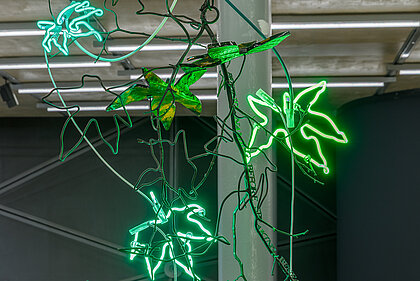
In her light sculptures, Andrea Bowers combines motifs from nature with feminist thinking to create an image of ecological interconnectedness. For the series Chandeliers of Interconnectedness, she created leaf-shaped chandeliers that hang from the ceiling. Made from recycled, non-toxic materials, the constructions are interspersed with neon light and glass fragments. Their shapes are based on the branches and foliage of sycamore trees, which are large and deciduous. Along the curved lines appear quotations from philosopher Susan Griffin, a pioneer of feminist and ecological ideas. Her book The Roaring Inside Her (1978) identifies the interconnections between environmental destruction, the degradation of women and racism. Bowers invites reflection on equality, solidarity and sustainable responsibility.

Image Credits

Andrea Bowers

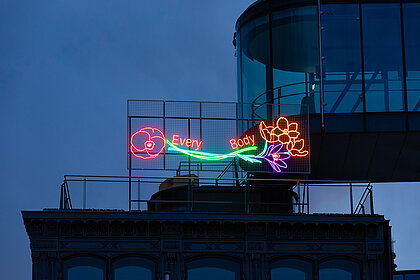
Every Body, 2026

For her neon installation on the terrace of the Kunsthaus Graz, Andrea Bowers created the slogan Every Body, which celebrates diversity and self-determination. Visible from the surrounding urban space, the glowing bouquet features local flowers such as poppies, daffodils and crocuses. The slogan comes from a protest sign for the rights of trans children in Washington, D.C. Bowers thus emphasises ecofeminist equality and the equivalence of all bodies, human and non-human. Her work combines ecofeminism with queer ecologies – approaches that highlight the connection between the oppression of women* and the destruction of nature, and deconstruct the dualisms of ‘man/woman’ or ‘natural/unnatural’. In doing so, she counters patriarchal and politically (right-wing) conservative narratives. Bowers also refers here to activist and lawyer Chase Strangio, who is fighting Trump’s transphobic policies in the courts.

Credits

Image Credits

Viltė Bražiūnaitė & Tomas Sinkevičius

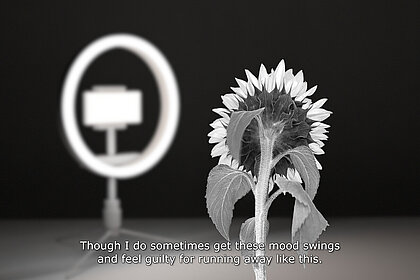
Sunflower, 2021/2023

In this video work, an ironic sunflower vlogs from its new home. It has exchanged the overheated sunflower field with its annoying bugs and people for an ‘artificial’ habitat: instead of sunshine, her video blog features a selfie ring light in a darkened room, and a hose system replaces vital groundwater. In this melancholic work, Bražiūnaitė & Sinkevičius combine grey 3D animation with colourful archive material. In a mix of artificial and natural images, complemented in the exhibition space by lounge furniture made from food industry boxes, they subversively explore how long we humans will continue to stretch out comfortably in front of the large screens in our living rooms – despite our knowledge of the climate crisis and capitalist exploitation.

Credits

Image Credits

Claude Cahun

Sans Titre, 1939

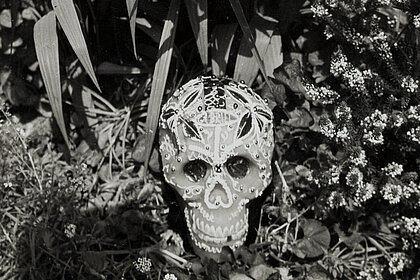
A note on the back of the photo reveals which flower Claude Cahun captured here: Hemerocallis fulva, an orange daylily. The daylily gets its name because each of its flowers is only open for a single day. This makes it a symbol of the fleeting nature of the moment. In the grass below, a sugar skull refers to the Mexican cult of the dead, in which life and death are understood not as opposites but as parts of a continuous cycle. The combination of these motifs reflects Cahun’s artistic interest in transitions and transformations. As a visionary surrealist artist and writer, she also used her visual language to fundamentally question fixed ideas of identity, gender and existence.

Credits

Image Credits

Regula Dettwiler

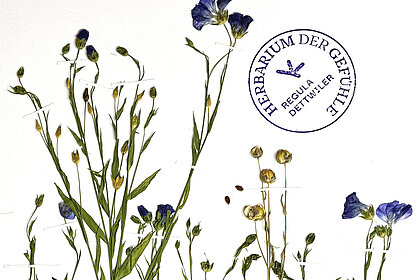
Herbarium der Gefühle, 2025/2026

 [Herbarium of Emotions] in 2025, Regula Dettwiler invites people to give her a pressed flower or a dried plant – along with a story they associate with the plant. Scientifically classified and carefully arranged, this creates a Herbarium der Gefühle. Personal experiences and feelings are poetically inscribed into the collector’s rigid order. The plant order thus takes on a social dimension – or a psychological one, for example when the dried plants are assigned to the seven basic emotions according to psychologist Paul Ekman (joy, sadness, anger, fear, surprise, disgust and contempt). Dettwiler’s project reflects the diversity of botany back onto us humans and gives the fleeting moments of life their place in the ‘emotional memory’.


Thanks to the Lower Austrian State Gallery, the initiator of the Herbarium der Gefühle


More of Regula Dettwiler in Speaking Through Flowers, Folk Life Museum, 21.05.2026–31.01.2027


Credits

Image Credits

Spencer Finch

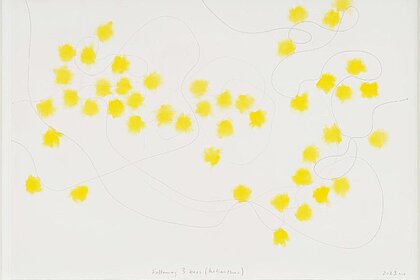
Following 3 Bees (Zinnias), 2008; Following a Bee (Helianthus), 2023

In his artistic practice, Spencer Finch worked in various media, always exploring the complexity of vision – how we see. And how we know what we see. In this series, he observes and draws bees, which in turn see flowers. Using GPS tracking technology, he mapped sunflowers and zinnias in his garden and, from a stepladder, followed the rest and flight path of a single bee from flower to flower. Finch’s drawing process follows the bee: when it pauses, the artist must also rest. In the spirit of author Emily Dickinson, whom Finch has also studied for many years, the study of nature requires patience and respect: ‘To be a flower is a great responsibility’.

Credits

Image Credits

Barbara Frischmuth

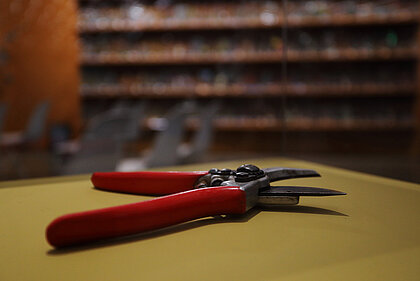
Secateurs, Diaries (garden journals)


Barbara Frischmuth was a feminist writer, advocate for minority rights and passionate gardener. In her gardening books, she advocated for plant and animal ethics and described the developments in her garden as a world of sensory experience between design and transformation. She devoted herself to philosophical, mystical and scientific questions, which accompanied her work on and with her garden with meticulous precision. The secateurs that Frischmuth bequeathed to the Franz Nabl Institute are a placeholder: they represent a beloved tool – and a way of relating to the environment and acting critically: ‘Wherever you make a cut, a wound remains, but sometimes the cut also promotes growth.’

Credits

Image Credits

Anita Fuchs

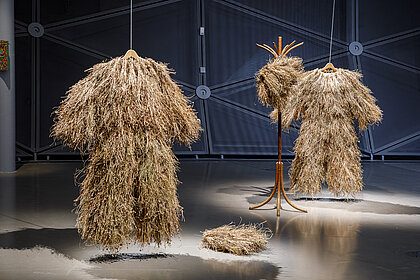
Ghillie Suit, 2025/2026

As you approach, the creatures hanging from the ceiling reveal themselves to be wearable garments – trousers, jackets and hats made of jute, with long tufts of grass and flowers sewn onto them. The title of Anita Fuchs’ work, Ghillie Suit, refers to camouflage suits that allow the body to blend in with its surroundings and are used in hunting, the military and nature photography. They owe their name to the Ghillie Dhu, a spirit covered in leaves and moss from Scottish folklore, who is said to be the protector of the forest. Since 2023, Fuchs has been running a wild plant area as an experimental space in the Vienna MuseumsQuartier. The plants and flowers for her protective suits come from there. Fuchs’ Ghillie Suits are guardians of a returning biodiversity, ready to stand up for ecological connections.


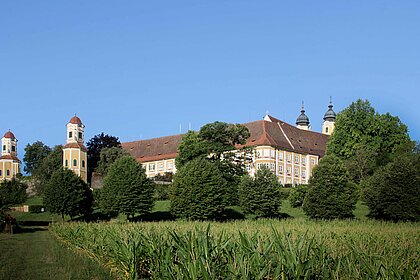
More on Anita Fuchs in Blooming Fields, Landwirtschaftsmuseum Schloss Stainz, 09.05.–31.10.2026

Credits

Image Credits

Yevhen Holubentsev

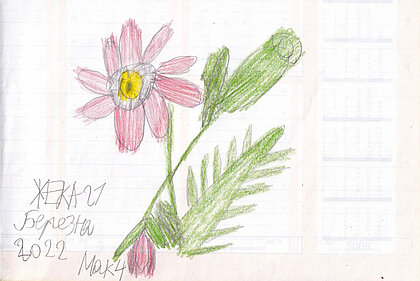
Poppy 4/Gelincik 4, 22.03.2022; Chamomille 3 / Papatya 3, 21.03.2022

Yevhen Holubentsev’s series of drawings are a kind of visual diary. Earlier flower drawings were created in Borodjanka, one of the regions of Ukraine most heavily bombed by Russia – in a war zone without electricity or heating and cut off from the outside world. Two of them appeared on the cover and in CRIP Magazine #5. In 2022, the artist fled to Bonn. He currently lives and works at the KAT18 studios in Cologne. His floral motifs serve as counter-images to omnipresent violence, as subtle commentaries on a society marked by war, social precariousness and ableist norms. In his current drawings, he reflects on his life in Germany as his new home. He adds Cyrillic inscriptions to everyday objects, plants and people. Holubentsev’s works are moments of resilience – symbols of perseverance, hope, but also understanding.

Credits

Image Credits

Sanja Iveković

Poppy Field, 2007

Poppy Field was an installation created by Sanja Iveković as a field of flowers at documenta 12 in Kassel. Iveković transformed Kassel’s Friedrichsplatz into a poppy field measuring over 6,500m2. Twice a day, revolutionary songs sung by activist women’s choirs from Croatia and Afghanistan were played in the field. In English-speaking countries, the poppy symbolises remembrance of those who died in war, while in (post-)socialist countries it stands for political resistance and struggle. The opium poppy, on the other hand, refers to the war in Afghanistan, which at that time had already led to an increase in opium production. The artist thus focused on the different political meanings of the poppy flower.

Credits

Image Credits

Anna Jermolaewa

The Penultimate, 2017

Anna Jermolaewa’s nine bouquets each symbolise a ‘colour revolution’. Colour revolutions refer predominantly to peaceful political uprisings, mostly directed against authoritarian and corrupt regimes and supported by the population. Each of them was named after a colour or a plant – from the red carnations of the Carnation Revolution in Portugal to roses, oranges, cedars, tulips, cornflowers, saffron, jasmine and lotus blossoms. Yermolaeva, herself politically persecuted and a refugee from the Soviet Union in 1989, addresses political upheavals, the struggle for freedom, and the fear of the powerful in the face of change emanating from the people in this still life. The title The Penultimate suggests that one last upheaval is still to come.

Credits

Image Credits

Markus Jeschaunig

Expanded Garden, 2026

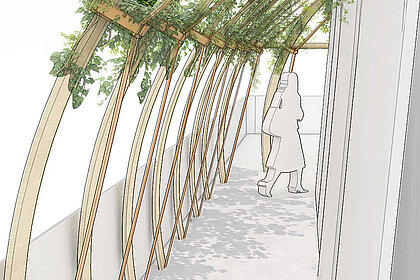
For Expanded Garden, Markus Jeschaunig installs an experimental air conditioning system on the roof terrace of the Iron House. Plants, water and wood form a system that cools through shading and evaporation. The multi-part intervention consists of light wooden slats on which self-climbing plants grow, while water from the groundwater cistern has a cooling effect on a seating area according to the principle of a graduation tower. Expanded Garden sees itself as a research prototype for climate-responsible construction and as a place for exchange and reflection on sustainability during guided tours and workshops. Jeschaunig’s title refers to the Mind-Expanding Programme of the avant-garde Austrian architect-artist community Haus-Rucker-Co.


With support of Institut für Architekturtechnologie, TU Graz; Botanischer Garten der Universität Graz; Abteilung für Bautechnik der HTBLVA Ortweinschule Graz; JH Naturrein Biogarten GmbH

Credits

Image Credits

Claudia Larcher

Aluna BLOOM, 2026

Interactive, dialogue-based AI guide for BLOOM at Kunsthaus Graz; custom GPT, iPad; soundfile

Can artificial intelligence – if radically anti-discriminatory, ecological and holistically fed – change the world for the better? Claudia Larcher’s artistic work explores technology and ecofeminist fairness, meaning equal relationships between humans, technology and nature without patriarchal exploitation. For the Kunsthaus Graz, she has developed Al-una, a feminist AI created by her and Eva Fischer in 2025, into a digital exhibition guide. Among other things, she has programmed Aluna with the exhibition's literature list to operate in key terms, including inclusion, human rights, cyclical thinking, regeneration, diligence and care work. With her knowledge, AIuna counters the reproduction of existing power and gender relations and calls for a sustainable and equal relationship between living beings and the environment.


More by Claudia Larcher and still lifes in Alte Galerie, Graz

Image Credits

Claudia Larcher

No. 2, from the series Still Life 3000, 2026

Generative reinterpretation of a Flemish floral still life, circa 1620. Original: Alte Galerie, Eggenberg Palace/UMJ; Giclée print, 3D-printed frame

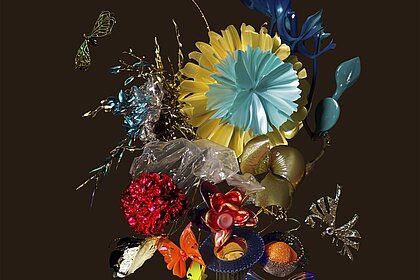
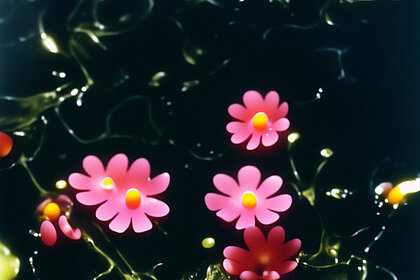
In her series Still Life 3000, Claudia Larcher brings digital, AI-generated flower arrangements into dialogue with the tradition of classical still life. Inspired by two Flemish ‘flower portraits’ from the early 17th century in the Alte Galerie collection, Larcher’s reinterpretations connect the past with the ecological, technological and socio-political challenges of the present. Traditional symbols of vanitas are revived in today’s context. Set pieces from our petroleum-based present, such as petals made of what appears to be plastic or a pollinator drone, refer on the one hand to modern technology and consumption and on the other to the loss of biodiversity and climate change. Is this what the floral still life of the future will look like?


More on Claudia Larcher and still lifes at Alte Galerie

Credits

Image Credits

Jonas Mekas

Requiem, 2019

For over three decades, Jonas Mekas captured flowers in countless shapes and colours, as well as trees swaying in the wind, meadows and leaves, using a variety of cameras. In Requiem, he interrupts the images of nature that he filmed from screens and newspapers with footage of war and destruction in the 20th century. Some of the flowers are typical of the vegetation in Lithuania, which he was forced to leave in 1944 after the Soviet occupation. As vanitas images, they are more a thanksgiving for the beauty and transience of the world than a warning. With Giuseppe Verdi’s Messa da Requiem (Requiem Mass) as its soundtrack, his film reinforces the theme of farewell, but goes beyond death and transience to celebrate the cyclical power of nature, which continually brings forth new life.

Credits

Image Credits

Joiri Minaya

Spandex installation, 2026

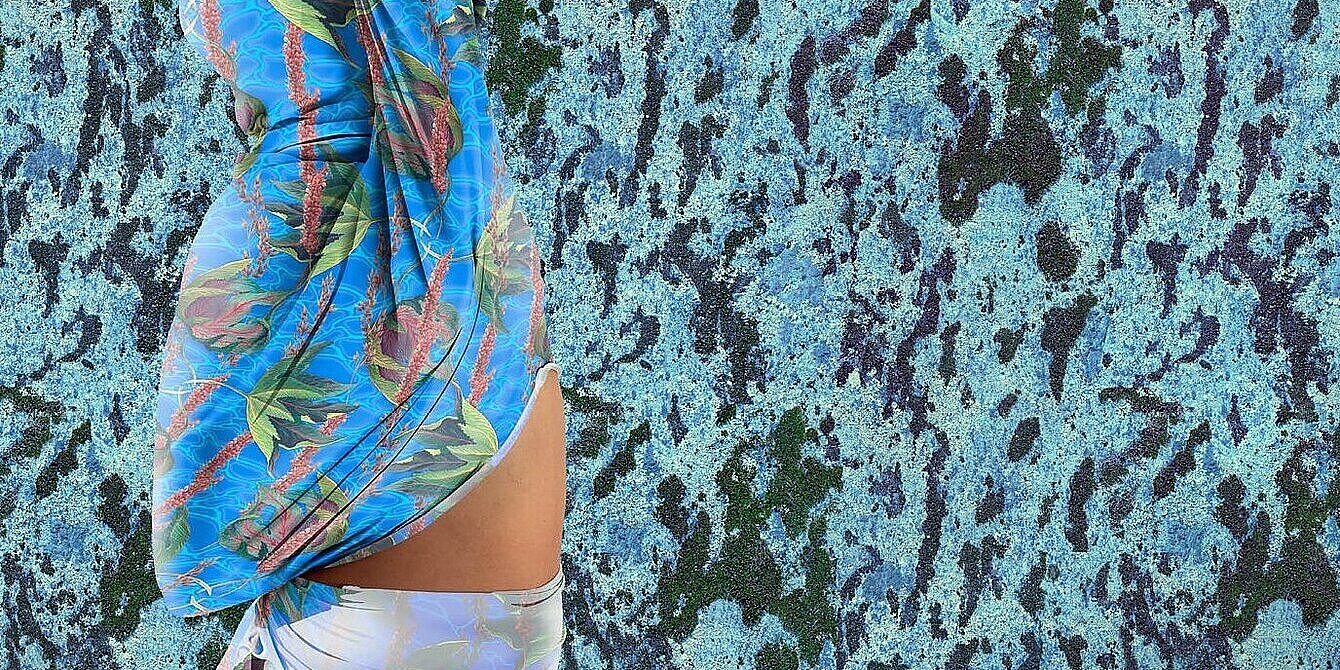
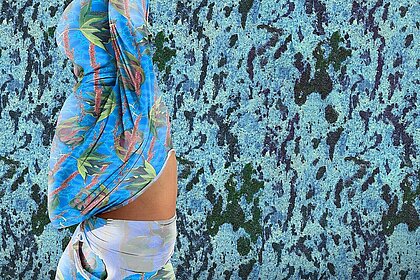
In her multimedia works, Joiri Minaya questions the aftermath of colonialism and exoticism. Her expansive textile installation is printed with tropical plants. Archduke Johann ordered exotic flowers such as fuchsias, which originate in the Dominican Republic, for the newly founded botanical garden (‘Joanneumsgarten’) in Graz – a reference to the colonial ties of Austria-Hungary. Minaya’s installation can be passed through via portal openings, allowing visitors to experience social, political or cultural exclusions on their own bodies. The work also encourages critical reflection on museums that are not equally accessible to everyone.


The photo collages Divergences features women in bodysuits with stereotypical tropical prints, constructed according to poses found from Google Image searches for ‘Dominican women’, reflecting on contested constructions of femininity in relation to national or regional identity and tropical nature.

Credits

Image Credits

Ryts Monet

Riserva Aurea, 2017 (2024)

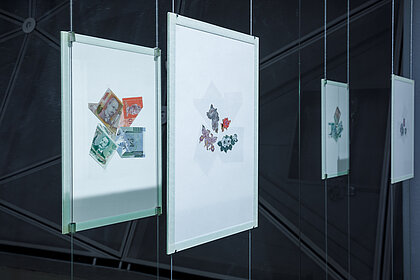
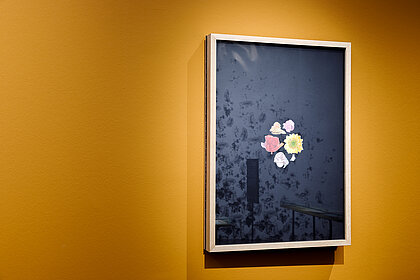
On closer inspection, Ryts Monet’s floral compositions turn out to be double-sided still lifes: elaborately folded banknotes appear as a bouquet of flowers on the front, and only when viewed in the mirror do the strikingly folded banknotes on the back become visible. This is made possible by the floral designs on the banknotes, which are intended to convey national identities and belonging as symbolic elements. The artist deals with the history of the 20th century, in particular the rise and fall of great ideologies. The Riserva Aurea, or gold reserve, he has assembled invites us to reflect on the history and future of the modern nation state and its financial systems.


More on Ryts Monet in The Blossoming Language of Money, Coin Cabinet 22.05.–31.10.2026

Image Credits

Ryts Monet

Riserva Aurea, 2026

Ryts Monet's floral compositions turn out to be double-sided flower pictures and only reveal their entirety and origin when the picture is opened. The selected banknotes feature flowers having a symbolic connection to revolutions or movements. The iconography of money is one of the most meaningful visual means of understanding how a society presents itself to the world. It is a system in which image, collective memory, power and symbolic value reinforce each other. Within this visual system, the flower may seem marginal, but it has political, cultural and territorial significance and plays an active role in shaping collective imaginations and processes of identity legitimisation.


More on Ryts Monet in The Blossoming Language of Money, Coin Cabinet 22.05.–31.10.2026

Credits

Image Credits

Alois Neuhold

Zwei Blumenfrauen am Herz-Ende, 2025; Blüten-Gefieder im Garten des Fühle-Vogels, 2025

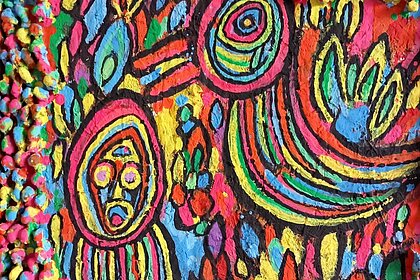
Alois Neuhold’s colourful, relief-like flower paintings are a blend of painting and sculptural design. Layer by layer, the vibrant flowers grow out of the dark background and develop an intense luminosity. The focus here is neither botanical interest nor decorative effect, but rather symbolic meaning: for Neuhold, flowers and blossoms reflect inner events – the innermost, the ‘inner garden’. Behind the seemingly childishly naive appearance lies a radical shaking up of conventions. Neuhold signs his works with ‘Neuvalis’ in a tongue-in-cheek homage to the early Romantic Novalis. It is in Novalis’ work that the blue flower first appears as a symbol of romantic longing for things that are sometimes difficult to name.

Credits

Image Credits

Agnieszka Polska

The Book of Flowers, 2024

In the video The Book of Flowers, Agnieszka Polska tells a ‘fictional story of our relationship with plants’, in which flowers and humans live together in close symbiosis. She uses archive material from the 1950s and edits it with AI. The flow of images and the story are accompanied by Charles-Marie Widor's Symphony No. 5, Toccata for Organ. Polska subverts the form of the educational documentary and raises questions about gender and hybridity. In doing so, she addresses the narrative itself, playing with the seduction of digital technologies and their influence on our perception. The film’s aesthetics are both fascinating and unsettling, ending with a warning: we humans could become victims of our own narratives – ‘shrunk and trapped – as small as a daisy’.

Credits

Image Credits

Anna Ridler

Circadian Bloom, 2021 – ongoing

New times? Circadian Bloom is a flower clock that explores how other living beings measure time. It shows chronobiological plants that open and close their flowers at set times. Certain flowers follow a precise daily rhythm that is adapted to local conditions. The images of the flowers are individual photographs and change in real time with the help of complex digital technology. Different seasons will show different flowers. Ridler refers to Carl Linnaeus’ system of a garden as a ‘flower clock’ – largely a concept, as a plant’s clock depends on geography, climate, light conditions and seasons and does not run strictly according to plan. For Kunsthaus Graz, Anna Ridler has also expanded Circadian Bloom as illuminated letters on the BIX media façade.

Credits

Image Credits

Ugo Rondinone

viertermärzzweitausendunddreiundzwanzig, 2023

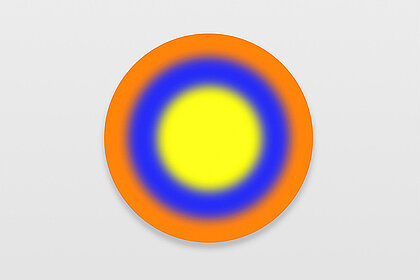
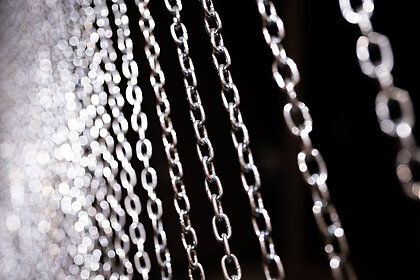
Ugo Rondinone's round canvas captivates viewers with its hypnotic circles of different colours. They are reminiscent of the flickering afterimages that can follow a direct glance at the sun. Alongside this, Rain – chains emerging from a cloud of spray paint and suspended diagonally from the ceiling – underscores Rondinone’s minimalist expression and his interest in natural phenomena. The artist focuses on the human perception of natural events. He often reduces his observations to simple shapes and lines. These become increasingly abstract and can ultimately stand as symbols for something greater – such as the interplay of nature, myths, spirituality or powerful cosmic forces.

Credits

Image Credits

Martha Rosler

Flower Fields, 1974

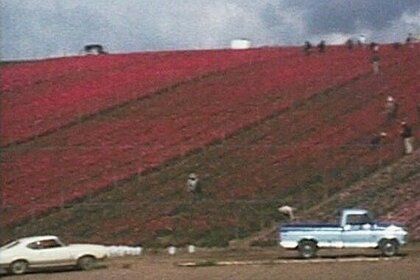
Flower Fields shows colourful fields of flowers along Highway 5 on the US west coast. Filmed from Martha Rosler’s car, the fields initially look like abstract colour field painting. However, when she zooms in, we can see people bent over, picking flowers for commercial trade – often migrant workers without secure residence status. Images of roadblocks set up by immigration police and a mobile bank branch are shown with the film footage. Idyllic images of palm trees and a glowing sunset can be read as a critical commentary on the precarious working conditions in the region’s flower industry. As an early work, the film anticipates Rosler's focus on social inequality, class and gender.

Credits

Image Credits

Sonya Schönberger

Kenyan Roses for the Kingdom, 2019

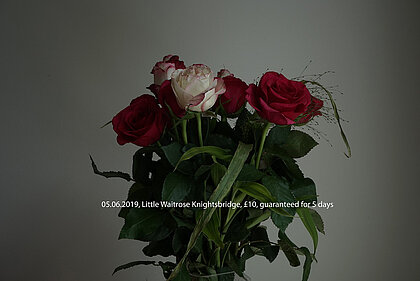
Is a rose always beautiful? Cheap supermarket roses are the focus of Sonya Schönberger’s research and art project on the global cut flower industry. Her starting points were the murder of Kenyan environmental activist Joan Root and the colonial and ecological interdependencies that continue to shape production and trade in Kenya, the world’s third-largest exporter of flowers. The artist traces the path of the rose from the farms on Lake Naivasha to European supermarkets. In doing so, she examines global trade structures and their impact on the local environment as well as the precarious living and working conditions around the plantations. She examines the rose as a cultural symbol – as a carrier of emotional, social and historical meanings – and contrasts this with its function as a global, cheaply traded mass commodity.

Credits

Image Credits

Nina Schuiki

Helenas Tränen, 2026

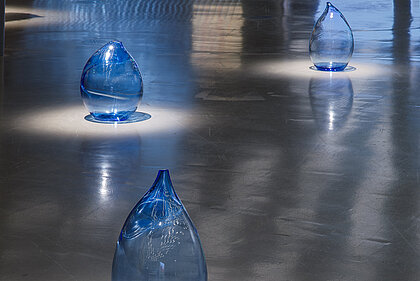
Nina Schuiki’s three glass vessels stand on the floor vents of the Kunsthaus Graz. Enriched with the ethereal scent of the ancient medicinal plant elecampane, a subtle healing cleansing takes place here through the power of a flowering plant known in Europe since ancient times. According to legend, the yellow-flowering elecampane – Inula helenium (Helen's herb) – grew wherever the tears of the demigoddess Helen fell. Elecampane acts as a disinfectant, especially on the respiratory tract, and takes two years to mature; a process of care that takes place for Schuiki at the Austrian Open-Air Museum Stübing. Craftsmanship, pharmaceutical and botanical knowledge are transformed here into a minimalist, poetic installation in which the institution becomes a healing organ that requires time for the precious interaction between humans and the environment.


More on healing knowledge and elecampane at the Austrian Open-Air Museum Stübing

Credits

Image Credits

Elfie Semotan

Photographs

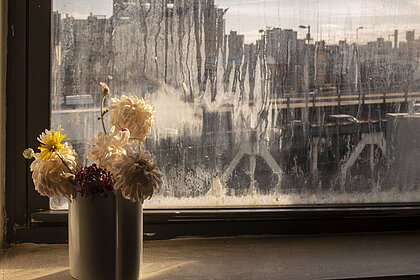
Elfie Semotan is best known for her idiosyncratic, cinematic advertising and fashion photography. The series of still lifes exhibited here shows that she also regularly staged everyday objects for the camera. The flower arrangements in vases and pots are unusually intimate and tell us as much about her immediate surroundings as they do about the woman behind the camera. Semotan’s works are marginal notes on her photographic explorations, documenting the beautification of her own fleeting everyday life. Or, as she herself puts it: ‘It was what was there – even as a woman and mother who continues to work during off-peak hours.’ The series is both a tribute to life and an act of resistance for her own individuality.

Credits

Image Credits

Petr Štembera

Grafting, 1975

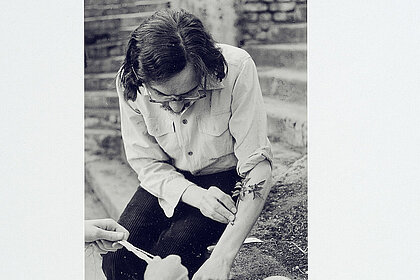
Grafting marks a radical moment in European body and action art. In this work, Petr Štembera connects his own body with a freshly cut branch, which he sews onto his forearm and carries around for a period of time. Grafting is one of the main methods of tree cultivation, in which two plants are connected so that they grow together permanently. The aim is to combine the good qualities of both parts – e.g. robust roots and high-quality fruit. Štembera shows a real attempt at biological connection between humans and plants. The photographic documentation serves as proof of this actual intervention, which plays with the limits of what is medically feasible.

Credits

Image Credits

Alexander Stern

From the series Kreisaufnahmen: Halm/ Löwenzahn, 1936-1946; Löwenzahn, 1936-1937; Kirschblüten, 1936-1946; Sonnensterne, 1936-1946

At the centre of Alexander Stern’s work are his experimental circular and serial photographs from the 1930s. By moving the negative during exposure or with the aid of specially constructed apparatus, he creates what are known as magicographs: photographs that transform movement, time and light into abstract image forms and break with photographic conventions. As a botanist at the University of Graz, he had access to microphotography, which had a lasting influence on his visual language. His working method is characterised by technical curiosity and scientific precision. The path to this artistic practice was marked by interruptions: after various professional positions, two world wars and political conflicts, he returned to photography in the mid-1950s.

Credits

Image Credits

Thomas Stimm

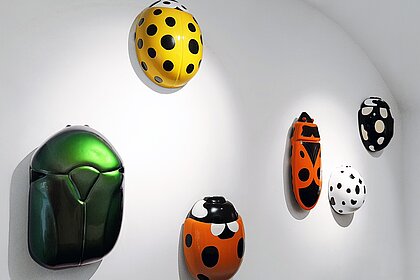
KÄFER, 2018; KÄFER (gelb), 2018; KÄFER (orange), 2018; KÄFER (weiß), 2018; KÄFER (Feuerwanze), 2018; ROSENKÄFER, 2018, KNOSPE, 2026

Thomas Stimm's dandelion sculptures greet visitors at Graz Central Station and in the foyer of the Kunsthaus Graz. With his series KÄFER [beetles], the artist also focuses on the smallest elements within the larger whole. Stimm isolates insects or tiny forms found in nature. He casts them from aluminium or carves them from PU and paints them in bright colours. In doing so, he explores the threshold between reality and art objects, between nature and culture. Instead of the mere form of a creature, the focus is now on growth, vitality and its relationship to humans. In this sense, Stimm’s work is an ongoing dialogue between the visible and the perceptible. Inspired by comics and pop art, he devotes his attention to the everyday, the incidental, and combines opulence, humour and resilience in his formal language.

Credits

Image Credits

Michael Stusser

Garden (University of California, Santa Cruz), 1971

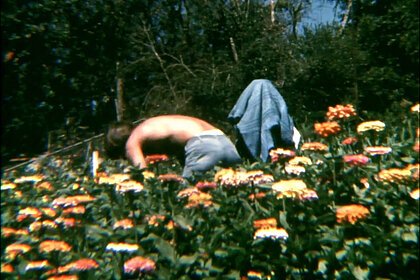
Garden is an artistic approach to the gardener-philosopher Alan Chadwick, whose teachings on biodynamic gardening and guidance for rigorous horticultural work had a significant influence on the development of ecological lifestyles in California. Originally a British actor, Chadwick had been taught by Rudolf Steiner. Steiner's anthroposophy understands nature and humans as being imbued with spiritual forces and forms the basis for biodynamic agriculture. At the invitation of the University of California, Chadwick taught students and transformed a barren hill into a ‘magically’ blooming garden. Michael Stusser worked in this garden as a student and experienced Chadwick’s holistic approach to gardening. In the film, which emphasises the sensory dimension of the garden, fellow student Norman O. Brown recites his poem My Georgics. In it, he considers work, poetic contemplation, man and nature as a unity.

Credits

Image Credits

Neja Tomšič

The Missing Pieces, 2026

Neja Tomšič is interested in the stories hidden in objects or vegetation. In this installation, she focuses on the ambivalently received ‘Aleksandrinken’: women who migrated from Slovenia to Alexandria at the end of the 19th century to work as wet nurses. There, the women planted a radicchio from their homeland, the Rosa di Gorizia. Tomšič transforms the leaves of this plant into reliefs, which in turn complement missing parts of the ancient altar in Ptuj. The altar features cultic representations of women: the Nutrices Augustae (‘sublime wet nurses’) were worshipped as goddesses and protectors of families and children. In this way, the artist brings forgotten stories and women to light and gives them space. 

Credits

Image Credits

Dirck Van Rijswijk

Mother-of-pearl inlay work, mid/late 17th century

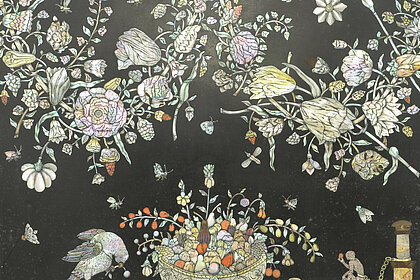
Van Rijswijk (1596–1679) created inlays from mother-of-pearl. The signed example shown here is in the collection of the Universalmuseum Joanneum. The floral mosaics consist of pre-cut elements of mother-of-pearl, coral and bone engraved with an etching needle. They are inlaid into dark wooden panels. Their composition follows the rules of contemporary Dutch still lifes. The work was created at a time of intense global trade relations and exploitation. From 1602 onwards, the Dutch East India Company brought East Asian luxury goods such as lacquerware and mother-of-pearl objects to Europe, providing artistic inspiration. Natural materials were traded and sold from the colonially occupied territories. In Europe, they were coveted objects for cabinets of curiosities.

Credits

Image Credits

Anna Zemánková

Untitled, circa early 1960s

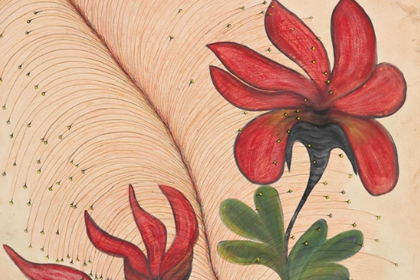
Fantastical plants and hybrid beings – the floral depictions of self-taught artist Anna Zemánková are valued for their sensual, erotic and meditative, dreamlike imagery. Zemánková worked as a dentist in Prague until the late 1950s when, following a period of severe depression, she turned her attention to painting. In early morning painting sessions, she created her own botanical universe with an imaginative biology that included the germination, wilting and reproduction of the flora she had conceived. In her own words, she cultivated ‘flowers that grow nowhere else’. Abstract references to dialectical female figures – between lover and mother – can also be found.

Credits

Image Credits

Sedimented Time, Sea Lily

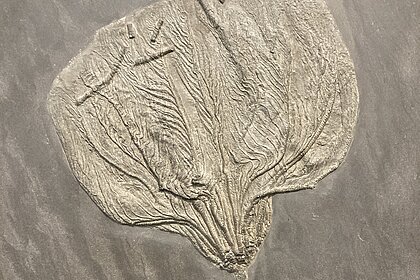
Pentacrinus subangularis [KH1] (MILLER, 1821); Sea lily in claystone, found in Metzingen, Germany; approx. 180 million years old (Jurassic period)

Over 180 million years ago, this sea lily (Latin: Seirocrinus subangularis) became a fossil. Its numerous arms, which unfolded like a fan in the water to filter food from the current, are reminiscent of plant tendrils, petals and ornamental patterns. Despite what its name suggests, it was not a plant, but an animal related to sea urchins and starfish. Its body resembles a flower, but its current form is rock. Many of its relatives once produced the limestone of our Alps. The fossil reveals various different temporalities: the lifetime of the sea lily, the geological duration of its fossilisation and our current observation. As a palaeontological object, it provides insights into past habitats and the long period of evolution.


Credits

Image Credits

Gate grille

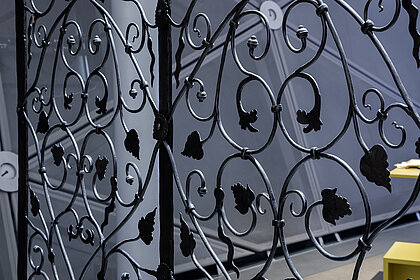
17th century, from Mariapfarr in Salzburg

The wrought-iron gate from the 17th century is a product of masterful craftsmanship that combines function and ornamentation. It protects and demarcates, but at the same time allows a view of what lies behind it. The gate reflects both the owner’s need for security and his desire for prestige: as a precious work of art, it is an expression of prosperity and artistic sensibility. The floral pattern is not a true-to-life reproduction, but follows a rhythmic repetition and a clear formal order. The result is a filigree structure of protective mechanisms, transparency and artistic design.

Credits

Image Credits

Rosa Luxemburg

Herbariums, 1914–1918

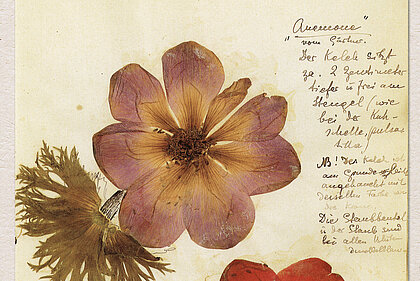
Born in what is now Poland, Rosa Luxemburg was a Marxist theorist, revolutionary and central figure in the socialist movement of the early 20th century. Due to her anti-militarism and commitment to opposing World War I, she was imprisoned several times. During her imprisonment, Rosa Luxemburg not only worked on political writings, but also pursued a passion from her youth: she originally wanted to become a botanist and created extensive herbaria. She obtained the plants from bouquets sent to her by friends. The herbarium specimens and accompanying correspondence reflect the analytical eye and precision that also characterised Luxemburg as a political thinker.

Credits

Image Credits

Wolfram Hannig

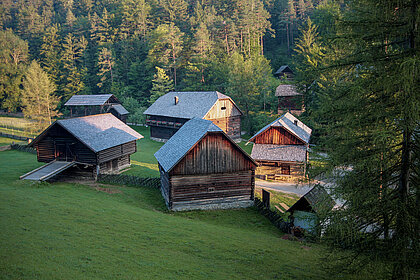
Plants of a world traveller: sand-dried plants in jars

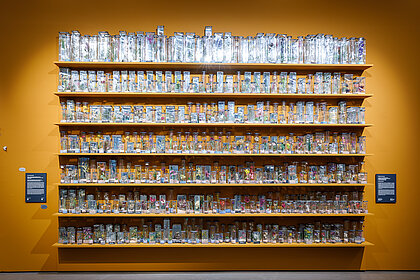
The plant collection of Wolfram Hannig (1923–2009) is the result of decades of travel and a very personal and elaborate collecting practice. Hannig, a dentist in Schladming, travelled mostly by car through Africa, Asia, South America, Europe and Antarctica. He brought back flowering plants, which he dried in sand and then displayed in specially made glass jars throughout his house and surgery. One jar containing daphne bears the note: ‘Now all Daphne species!’ – an indication of his delight at having achieved completeness. Hannig was an enthusiastic collector who was guided by his love of form, colour and diversity, as well as by collecting as an aesthetic practice. However, his collection does not follow any scientific methodology in the botanical sense.

Credits

Image Credits

Rococo clock

Porcelain clock, mid-19th century, Vienna

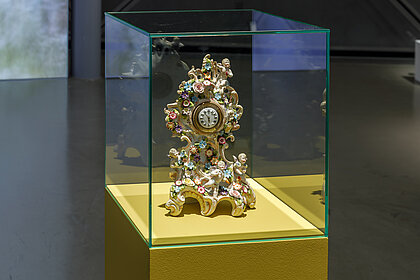
The richly decorated clock case features flowers and blossoms that are not rendered realistically, but freely interpreted as symbols of dynamism, rhythm and growth. The four seasons are depicted, which as a design element radiate pleasure and joie de vivre rather than transience and the passage of time. Carpe diem! this clock seems to admonish: take your time, enjoy it – don’t simply measure it. The designers of the clock are unknown. However, their finely crafted blossoms and the carefully designed transitions between ornament and construction reveal great craftsmanship. In the 19th century, decorative floral motifs were extremely popular, and designers often drew on past artistic eras: in this case, the playful Rococo style.

Credits

Image Credits

Field post letters from Karl Kraft to Christine Frühwirth

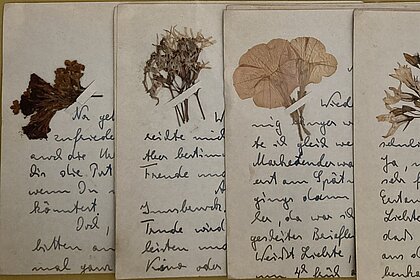
Handwritten field post letters, many of them decorated with painted or pressed flowers from the Balkans, tell the love story between front-line soldier Karl Kraft and Christine Frühwirth from Wildon. In 1942, Christine received her first letter from Karl, whom she did not know, who wanted to correspond with a ‘girl from home’ in order to share his joys and sorrows from afar. Decades later, social historian Joachim Hainzl discovered a total of 416 letters at a flea market in Graz. The flowers serve as a gesture of love, an expression of human connection and a sign of aesthetic resistance. Karl’s final letter reached Christine in February 1945, a few days before his death in Croatia.

Credits