
Hybrid Pleasure Helen Chadwick Supported by Liesl Raff

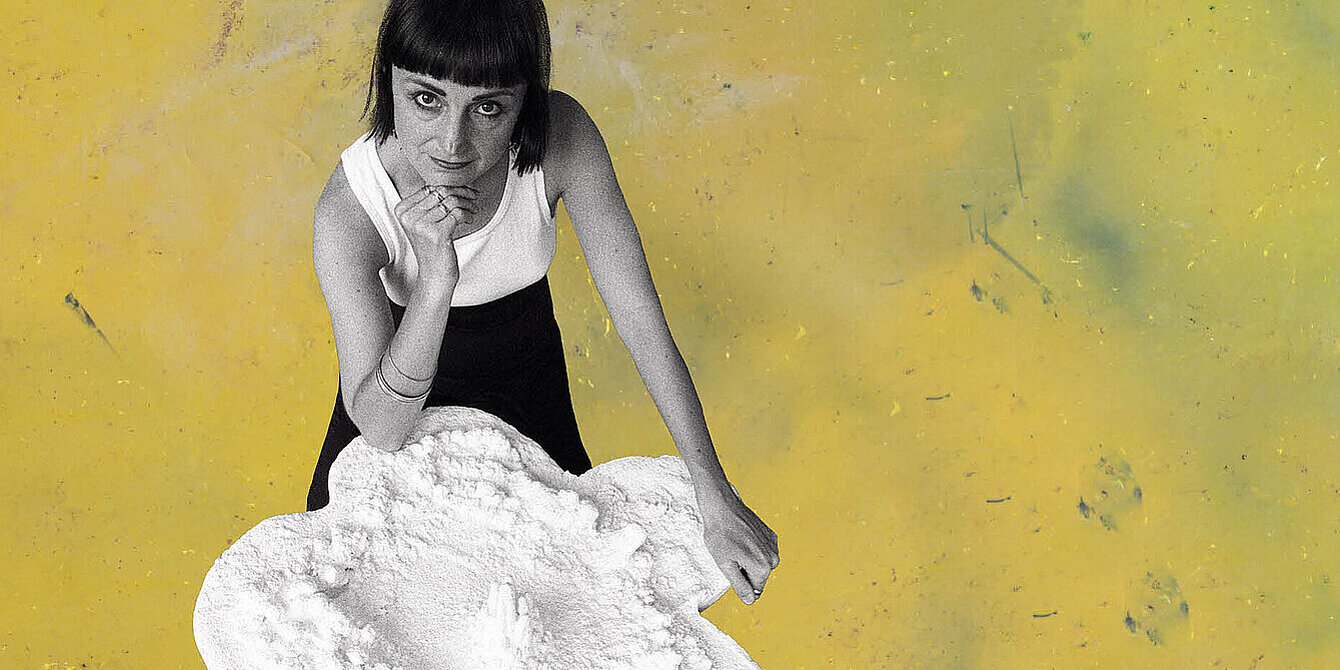
Her sculptural and performative works explore the sensual aspects of nature while questioning traditional notions of beauty. In dialogue with the sculptor Liesl Raff, new perspectives emerge: Raff makes connections, surfaces, and supports sensorially tangible. The exhibition brings together iconic works by Helen Chadwick—from In the Kitchen to the Piss Flowers—with Raff’s current practice, creating an intense, multisensory survey.

Image Credits

Chadwick & Raff: Sensuality in Hybrid Worlds

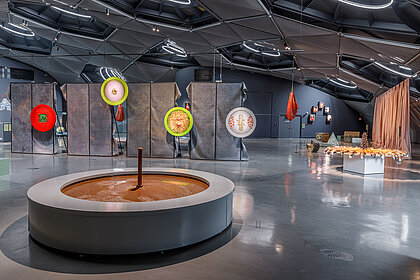
For the first time in more than 20 years, the Kunsthaus Graz presents the radical work of Helen Chadwick in dialogue with recent sculptures by Liesl Raff. Chadwick’s works combine sensuality, provocation, and hybridity—flowers, flesh, or chocolate become poetic elements that dissolve boundaries between body, nature, and material. Raff’s sculptures respond haptically and fluidly to these spaces, making connections, surfaces, and supports tangible while opening new perspectives on material and the body.

The exhibition creates a “third space” between past and present and is further activated through live events and performances. It forms part of BLOOM, the flower-focused program of the Universalmuseum Joanneum.

Works in the Exhibition

Image Credits

Nostalgie de la Boue, 1989

Helen Chadwick

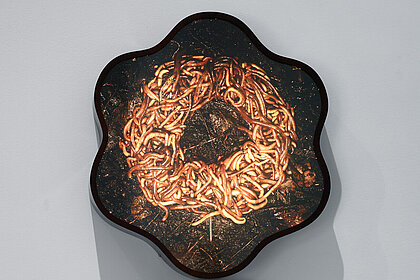
Nostalgie de la Boue comprises an infinity sign of two rounded cibachrome transparencies. The top one – a floral shape – shows a circle of earthworms writhing in the dirt, while the bottom depicts a human scalp with the crown collapsing as though it has been shot. The work’s French title references a desire for degradation and vice. It translates as ‘mud nostalgia’, a term coined by the poet and playwright Émile Augier (1820–89). His most famous play Le Mariage d'Olympe (1855) is about a woman who cannot escape her salacious past and is eventually the victim of a shooting. In the play, when the character Montrichard is asked whether a duck placed on a lake filled with swans will eventually miss his pond, he replies: ‘La nostalgie de la boue! [Longing to be back in the mud!]’

Courtesy

Image Credits

Carcass, 1986

Helen Chadwick

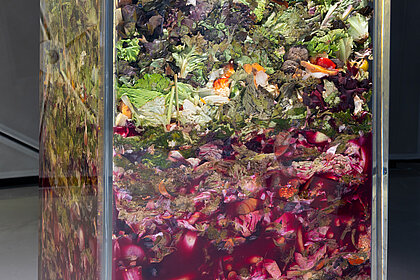
Carcass is a 2-metre-high box into which Chadwick originally poured the food waste from The Oval Court as well as that of her neighbours on Beck Road, regularly topping it up over the course of its exhibition. Designed to be like a giant digestive system or compost machine, the layers of rotting food initially form stripes and strata that then dissolve as the organic material breaks down. Playing with the relationship between revulsion and captivation, Carcass elevates that which is usually disregarded to a far higher status. The rotting compost generates new organisms and forms of life through the processes of decay, and thus takes on a life of its own. As Chadwick describes: ‘what I hadn’t anticipated was the fact that there would be this fermentation process, particularly with the weight compacting the lower, older material down, and it was constantly percolating bubbles which you could watch kind of fizzing up. So … it became more a metaphor for life.’

Audio by Helen Chadwick, Carcass (101)

Credits

Image Credits

Meat Abstract

Helen Chadwick

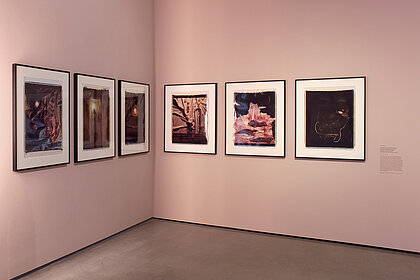
Chadwick’s Meat Abstracts are made with a large-format Polaroid camera. In these pieces, she created compositions of fresh meat; steak, tripe, offal, liver, hearts and kidneys, lovingly arranged like seventeenth-century still lifes on sheets of coloured silk, velvet, leather or fur, occasionally accompanied by metallic spheres or cutlery. In all of the images a glowing light bulb illuminates the scene, sometimes buried inside the meat, sometimes silhouetting it from behind, and sometimes pointing at it directly so that it glistens wetly. The images are shot directly from above to create a shallow depth of field and single plane of focus. The works resemble imagery associated with luxury fashion accessories: bags, jewellery, scarves etc. While making the Meat Abstracts, Chadwick was deeply influenced by the films of David Cronenberg, as well as the story of Frankenstein and his monster. She was keen to find a way of reanimating the inanimate. To bring meat to life with electricity and light.

Courtesy

Image Credits

Enfleshings I, 1989

Helen Chadwick

This work comprises of a large Cibachrome transparency lit from behind, depicting a starkly composed photograph of vivid red meat with a light bulb embedded within – the actual light source blurring with the depicted light source. Chadwick was originally inspired to utilise sources of light in her installations from her lamplight viewing of the prehistoric paintings in the caves of Perigord, France. Chadwick described her Enfleshings as: 'intimate encounters with equivalents for our bodies. We read them as a kind of equivalent for a human organism I think, or a projection of what we feel about our bodies.' Due to the central position of their light, the Enfleshings provide a powerful assertion of consciousness as centred within the body rather than operating from a detached and superior position in relation to it.

Courtesy

Image Credits

Agape, 1989

Helen Chadwick

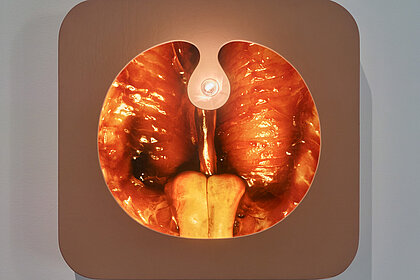
In Agape the enormous, glistening inside of a mouth, wide open, almost urges us to climb inside. The dangling uvula is lit brightly by the light behind so that it glows, while the back half of a tongue in the bottom of the image seems to say ‘ahhh.’ The title plays on several meanings of the Greek-derived word ‘agape’ – obviously referring to one’s mouth being wide open in surprise or wonder, but also referencing the Greek word often translated as ‘love’. Distinct from ‘eros’ (romantic love) or ‘philia’ (brotherly love), ‘Agape’ is a love that is not based on personal desire, but on a commitment to the well-being of others. This higher form of love is selfless, unconditional and giving, a love of wonderment and vulnerability.

Courtesy

Image Credits

Piss Flowers, 1991-92

Helen Chadwick

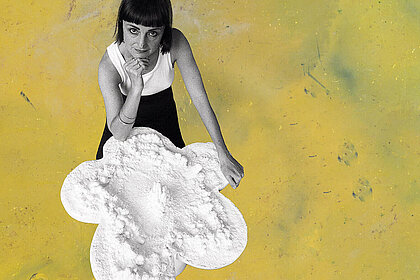
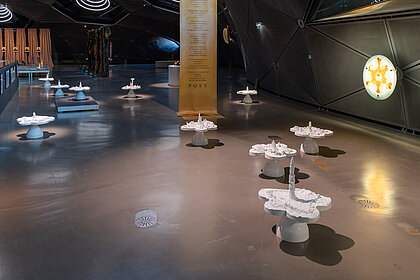
During a residency at the Banff Centre for the Arts in Alberta, Canada, Chadwick and her husband David Notarius travelled into the Rocky Mountains with a large cookie-cutter mould of a flower. They densely packed snow into the mould before taking turns to urinate into it. They then poured liquid plaster into the cavities, which was cast in bronze and enamelled white so that the forms made by the hot urine rise into the air, creating a garden of gleaming stalactites and spread petals. Flowers are the reproductive systems of plants and often contain male and female sex organs. In Piss Flowers Chadwick’s urine produces the central - phallic – form (because female urine is hotter than mens, and is expressed with more speed), while Notarius’ has a more decorative, subtle effect, creating the texture of the petals. Through their mischievous inversion of traditional gender roles, Piss Flowers deliberately play on sexual difference and muddy the whole notion of gender singularity.

Audio by Helen Chadwick, Piss Flowers (102)

Credits

Image Credits

I Thee Wed, 1993

Helen Chadwick

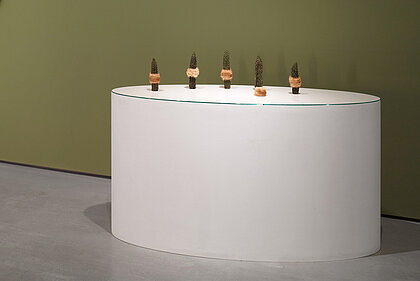
I Thee Wed consists of 5 hyper realistic bronze casts of bitter melons (phallic like vegetables), each fitted with a ring made of fur. The phrase ‘I thee wed’ was traditionally used during the ring exchange of a wedding ceremony, though in Chadwick’s work, the ring for the fourth ‘finger’ – the ring finger in Western wedding ritual – remains unworn and off to one side. Deliberately teasing the systems and customs of marriage, Chadwick’s use of the phallic form also alludes to sex – and the fur to sex toys – in a confident yet mischievous merging of eroticism and matrimony. Working during the 1980-90s amid the AIDS crisis, many of Chadwick’s works are informed by sex and disease.

Courtesy

Image Credits

Wreath to Pleasure, No. 4 (White Narcissi, Soapsuds), 1992-93

Helen Chadwick

Chadwick’s Wreaths to Pleasure is a series of 13 circular photographic works depicting different arrangements of flowers, petals and blossoms in slightly suggestive shapes, suspended in a range of liquids, some pleasurable, some toxic. Chadwick uses flowers such as dandelions, tulips, daisies, and sweet peas, floating in liquids including tomato juice, milk, Fairy Liquid, bubble bath, and chocolate. The fluidity of the liquid clashes with the stillness of the arranged flowers and the results are heady, almost scented or fizzing. The circular frames resemble biological or cellular forms, the building blocks of life. While their titular ‘wreaths’ make a clear connection to themes of death and mourning, Chadwick also nicknamed them ‘bad blooms’. They are both seductive and risqué, recognisable and disconcerting, combining wet and dry, beauty and poison.


More about edible flowers in the exhibition Blooming Fields. Into the Blue at the Agriculture Museum Schloss Stainz, from 09.05.2026

Courtesy

Image Credits

Cacao, 1994

Helen Chadwick

Cacao is a monumental fountain filled with around 800kg of liquid milk chocolate. The title refers to the raw seeds used to make chocolate and cocoa. Here Chadwick plays with the boundary between repulsion and desire; this sickly-sweet artwork is immediately sensual, delicious and tantalising, but may quickly become nauseating and indulgent in its excess. Chadwick tested many types of chocolate to get the exact molten texture she wanted, she wanted it to move but not splash, and to bubble, gurgle, and pop. The constant, audible movement within the work has been described as a reference to libido and desire. Chadwick said, ‘my libido demanded it, a pool of primal matter … in a perpetual state of flux’. With the fountain’s phallus/stamen-like spout there is also reference to the hermaphroditic cacao plant and Chadwick’s further exploration of gender in her work Piss Flowers (1991–92).


More about enticing fragrances in the exhibition Flowers, personally. Of myths, symbols, fragrance and love at Schloss Trautenfels, from 01.05.2026

Audio by Helen Chadwick, Cacao (103)

Courtesy

Image Credits

Ego Geometria Sum 1: Incubator – Birth, 1983

Helen Chadwick

At 30, Chadwick felt a need to return to the body, to explore her childhood and identity: ‘I felt alienated from my own sense of self, so I thought … embarrassment a-go-go, let’s do something autobiographical’.

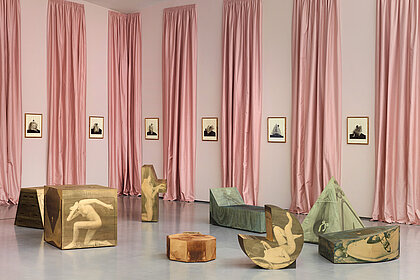
These geometric sculptures represent containers for her body at key moments of her life: an incubator from her premature birth, the playtent she shared with her brother, a vaulting horse from school gymnastics, and a cube symbolising high school. Powerful and personal, these are objects that contained, reoriented and shaped Chadwick. The size of each form reflects Chadwick’s mass at each age, while their arrangement in a large, mathematical spiral gives structure to the messy notions of memory and change. Chadwick was also alluding to Johannes Kepler’s theory of the universe as a cosmic design that is made by God and governed by the principles of geometry.

Chadwick was interested in photography’s three-dimensional potential. For this work she developed a new printing method, where a photosensitizing emulsion called ‘silver magic’ was layered onto the plywood, onto which her ‘self-portraits’ were then exposed.

Audio by Helen Chadwick, Ego Geometria Sum (104)

Courtesy

Image Credits

The Labours I - X

Helen Chadwick

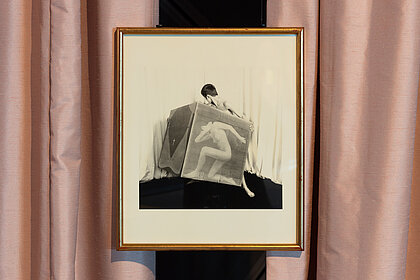
Working with the photographer Mark Pilkington, Chadwick reproduced herself again in The Labours, posing naked and anonymous (her face is never shown) interacting with each sculpture from Ego Geometria Sum. This allows the viewer to project their own childhood experience and memories onto the work. Her body becomes all bodies, a bridge between past and present. The title refers to the Greek myth in which Hercules was ordered to perform twelve perilous labours. Chadwick offers a feminist reinterpretation of this, with depiction of her physical strength, lifting her own sculptures. She also alludes to the Caryatides, the six female statues supporting the roof of the temple dedicated to Athena (goddess of wisdom and strategy) in the Acropolis in Athens, Greece. This is a deliberate reference that symbolizes the strength, intelligence and fearlessness of women.

Courtesy

Image Credits

Glossolalia, 1993

Helen Chadwick

After sourcing fur scraps from an old tannery, Chadwick made three works, Glossolalia, Adore/Abhor, and I Thee Wed, continuing her rebellious use of unusual and exotic materials.

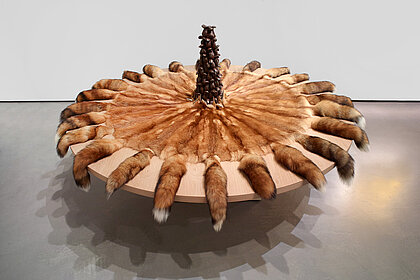
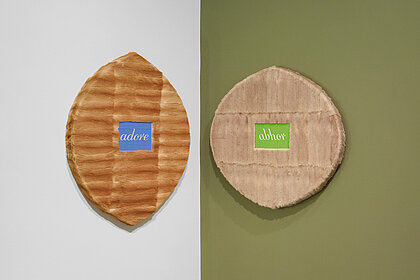
Furry and floral, Glossolalia is a circular oak table topped with fox pelts arranged petal-like in a circle and sewn together. They surround a large bronze stamen or phallus, cast from a collection of lambs’ tongues. Chadwick uses the flower as a metaphor for the beautiful intensity of the sensual and its constant change: ‘A lot of my work relates to sex … Art is one way to explore that synaesthesia of experience’. Nearby the vagina-shaped plaques of Adore/Abhor show the interplay between desire and repulsion, sex and loathing, pleasure and pain. Being both repulsive and luxurious, these works confront thoughts around comfort and desire: who decides what desire is, and what and who is desirable?

Courtesy

Image Credits

Allegory of Misrule, 1986

Helen Chadwick

‘Stung by the whiplash of a monstrous catastrophe, I awake in the middle of the night … Just a bad dream, the persistent nightmare of our times … I began to wonder how I might stretch that terrible moment out, to contemplate it and discharge its hold.’ In 1986, Chadwick undertook a residency at Birmingham City Museum and Art Gallery. This is where she created Allegory of Misrule, recreating an 18th-century oil painting of the same title in the museum’s permanent collection by Johann Georg Platzer (1704–61). Here she layers her own photocopied materials and slide projections, as well as photocopies of the taxidermied animals in the museum’s Natural History department. Chadwick’s reinterpretation of Platzer’s work explores the effect of misrule; simultaneously depicting anarchy and mayhem, beauty and revelry. The background imagery of an atomic explosion – Nagasaki – looms over the figures in the work, creating an all-encompassing feeling of catastrophe.

Courtesy

Image Credits

Study for Arsehole, c. 1989 Untitled (Lacquer Blue Turquoise), c. 1989

Helen Chadwick

Colour lithographs on BFK Rives paper 

The Estate of Helen Chadwick, Courtesy Richard Saltoun Gallery, London, Rome and New York

Image Credits

Loop my Loop, 1991-92

Helen Chadwick

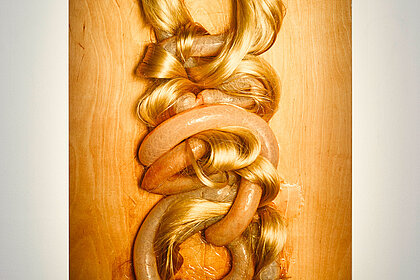
Loop my Loop is another of Chadwick’s lightbox works. It juxtaposes a beautiful lock of false blonde hair intertwined tenderly with a pale pink twist of pig intestines, both glistening in the photographic light like a modern Baroque still life. Here the lock of hair (often a fetishised form of femininity and regularly given as a traditional Victorian keepsake to a sweetheart) signifies love, while the pig intestines imply a more primal, animalistic side to human relationships. Once again Chadwick disrupts our expectations; the most ornate image associated with beauty is made repellent through its positioning with something also natural, but out of context, visceral and grotesque.

Courtesy

Image Credits

Billy Budd, 1994

Helen Chadwick

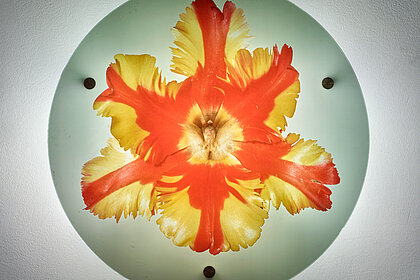
In this work, the frame is absorbed by a close-up of a Tiger Tulip flower. The stamen of the flower is replaced with an intimate image of male genitals, juxtaposing this male sex organ with the traditionally feminine flower, and heightening its vulnerability as well as its sexual potency.

The work’s title, Billy Budd may also be a reference to Herman Melville’s 1924 novel of the same name, which charts the rise and fall of an innocent sailor. His incorruptible goodness is bluntly contrasted with the malevolent world around him. By choosing Billy Budd as the title, Chadwick employs her characteristic use of irony and perhaps alludes to offering a queer interpretation of this well-known story.

Courtesy

Image Credits

Ruin, 1986

Helen Chadwick

Cibachrome photograph 

The Estate of Helen Chadwick, Courtesy Richard Saltoun Gallery, London, Rome and New York

Image Credits

The Oval Court, 1984-86

Helen Chadwick

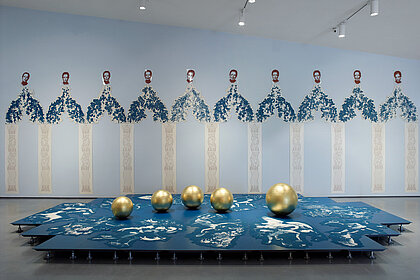
In this huge aquamarine collage, twelve images of Chadwick swim amidst a fantasia of flora and fauna. While atop the platform the five large gold spheres suggest the touch of divine fingers. The Oval Court was made with a Xerox machine, received through sponsorship. Chadwick enjoyed the photocopier as a medium, describing it as ‘extraordinarily direct and efficient’. This work is ‘a stitching together of so many different references.’ Influenced by Rococo and Baroque architecture, Chadwick visited churches and cathedrals during its creation, flipping their heavenly ceiling paintings and pulling them into an earthly realm. She also took her facial expressions and poses from artworks of this period, including Gian Lorenzo Bernini’s The Ecstasy of Saint Teresa (1647–52), Jean-Honoré Fragonard’s The Raised Chemise (c. 1770) and François Boucher’s The Blonde Odalisque (1775). This is one of art history’s most extensive exercises in self-imaging. It is a joyous, uninhibited celebration of the union of Chadwick’s own body with nature. 

Audio by Helen Chadwick, The Oval Court (106)

Courtesy

Image Credits

One Flesh, 2002 [Original 1985]

Helen Chadwick

One Flesh depicts a mother and her child. The surrounding red cloth reveals the mother as Holy Mary, mother of Christ. In traditional medieval paintings the scene of Madonna and Child is formed in a pyramid with the Holy Spirit at the apex. In this depiction Chadwick completes her pyramid with a photocopied image of a placenta replacing the Holy Spirit. (Like other works of hers, One Flesh was created using a Xerox photocopier.) In a further subversion, one of the mother’s hands also points to the fact that the child is a girl, Christ as a female. And following the direction of this pointing finger further, an umbilical cord spirals toward the ground. While the mother’s other hand considers cutting the cord still attached to the infant. This is a sensitive and delicate reimagining of the traditional Madonna and Child scene, thought about from a feminist and maternal perspective.

Audio by Helen Chadwick, One Flesh (107)

Courtesy

Image Credits

Carcass (photograph), 1986

Helen Chadwick

Cibachrome photograph 

The Estate of Helen Chadwick, Courtesy Richard Saltoun Gallery, London, Rome and New York

Image Credits

Kissing Chancre, 1989

Helen Chadwick

Cibachrome transparency, leather, tulipwood, plywood, electrical apparatus, in two parts 

The Estate of Helen Chadwick, Courtesy Richard Saltoun Gallery, London, Rome and New York

Image Credits

In the Kitchen, 1977 [printed in 2018]

Helen Chadwick

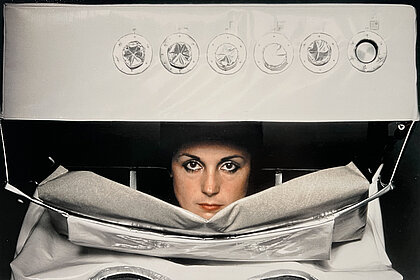
The twelve photographs feature wearable sculptures that resemble various household appliances. These were worn as costumes by Chadwick and some of her fellow students for performances at her master’s degree show. They reflect stereotypical social roles and restrict the women’s freedom of movement – both literally and figuratively. 

Courtesy

Image Credits

Face Mask, 1974

Helen Chadwick

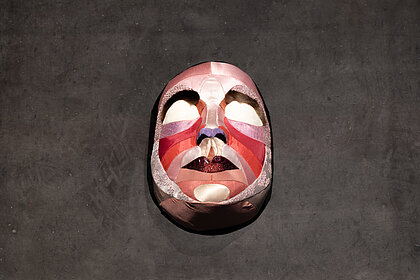
Face Mask is a work created for a performance while Chadwick was a student in Brighton. In film, sculpture and video, Chadwick always focused on her own body. She made casts of her face from edible jelly (Untitled (Eat Art), 1973), and made chocolate shaped like body parts, as well as costumes and face masks.

The mask is modelled on the shape of her own face. The different, subtly shaded fabrics recall both traditional Victorian (‘feminine’) handicraft and the butchery diagrams of animal carcasses one finds in old cookbooks. It refers to the objectifying view of meat that judges its quality and tenderness, which is also applicable to human gender relations and the appraising male gaze.

Courtesy

Image Credits

Lofos Nymphon, 1987

Helen Chadwick

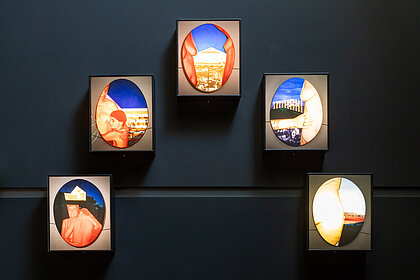
In Lofos Nymphon, Chadwick draws on a family story about marriage and lost inheritance. The title refers both to the Hill of the Nymphs – the location of the National Observatory of Athens – and to Odos Nymphon, where her great-grandfather built a house for her mother. When she left Athens in 1946 to marry an English soldier, her mother lost the property. The work shows five photographs of Chadwick and her mother posing naked on the balcony of the lost house, which are projected onto egg-shaped painted panels. In reference to the installation of the work in a hexagonal room in 1987 in the exhibition The Body Politic, it is shown in a parabolic arc at the Kunsthaus Graz. The images surround the viewers in a space of familiar intimacy and trace both the landmarks of Athens and the path of the sun, from the observatory at dawn to the Pnyx at dusk.

Courtesy

Image Credits

Adore/Abhor, 1994

Helen Chadwick

In Adore/Abhor, Chadwick displays two vaginal-shaped, fur-covered plaques on the wall – one bearing the word Adore, the other Abhor. As a recurring theme in her works, she explores intellectual contradiction and emotional ambiguity as an essential part of life. The use of an unexpected material – shaved animal fur – is consistently subversive and physically direct. The work is strongly reminiscent of Meret Oppenheim’s Object (1936), a teacup covered in fur. The seductive, sexual power of hair was a key recurring motif for the Surrealists, and was used by Chadwick in her provocative works to produce reactions that are free from social stereotyping and with maximum authenticity.

Courtesy

Image Credits

Diaphragm f/m, 1993

Helen Chadwick

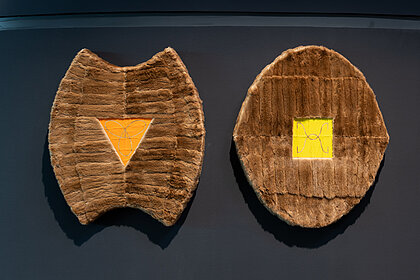
Like Adore/Abhor, the work Diaphragm f/m uses shaved fur for a pair of panels, producing a clear relationship between the forms with shamanistic symbols of masculinity and femininity. The diaphragm is a hormone-free contraception method that women insert themselves as a small barrier that covers the cervix and so – like the pill – represents self-determined pleasure for women.

Courtesy

Image Credits

Hangers, 2024/26

Liesl Raff

For some years now, Liesl Raff has been using latex to open up physical dialogues. Extracted from the rubber tree, the latex when cast becomes a second skin that morphs onto everything it is placed on. Bulges and folds interplay with the structure of the carrier, producing a deeply haptic effect. Tinted with dark pigments, the Hangers and their supports become material actors in the space. Their shape makes us think of banners, relating to everything around them. Put to one side, they seem to be waiting; they convey the image of both a protective shield and a collective surface of communication – they could be used as a way of assembling and connecting.

Courtesy

Image Credits

Sheet (Helen), 2026

Liesl Raff

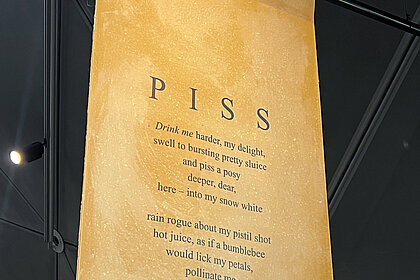
Sheet (Helen) is Liesl Raff’s direct homage to Helen Chadwick’s wonderfully ironic poem Piss Posy. Printed in the catalogue of the solo exhibition POESIS (Salzburger Kunstverein, 1994), the poem is Chadwick’s piece accompanying her Piss Flowers and a humorous critique of the restrictive gender discourse defined by Carl von Linné’s binary classification system of nature. Raff has carefully brought the poem into the space, taking the same elongated typeface onto soft, semi-transparent latex; the delicate, skin-like object supports and expands the poem in its corporeality. Together with the title ‘Sheet’, Chadwick’s subversive undertone is combined with a multi-dimensional, sensuous experience of the world.


More on flowers, sexuality and attributions at the exhibition Flower Sex. The Colourful Love Life of Plants at the Natural History Museum, from 24.04.2026

Courtesy

Image Credits

Platform (Helen), 2026

Liesl Raff

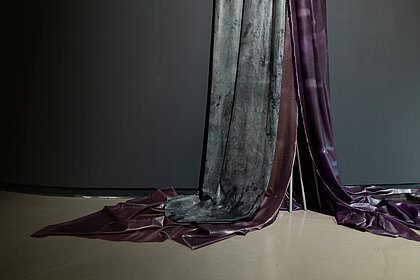
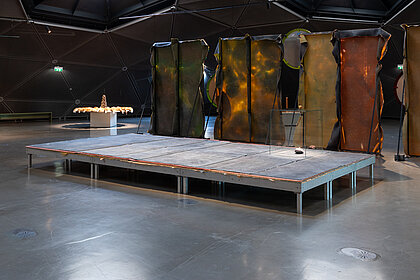
Cast latex sheets of different shades lie on standardised stage elements, creating an independent sculpture and also a stage space and platform. The nuances of colour shimmer through, in constant flux as they interact with viewers’ movements. During the exhibition there will be performances on the stage, which also serves as a platform for the silk mask from one of Chadwick’s burlesque feminist performances (1976). This represents and connects to the absent artist, while also reflecting the role play in the process of becoming and passing away. In this way, Raff’s Platform marks itself out in the middle of the space as a commitment to the fundamentally hybrid, its softness inviting contact and kin-making.

Courtesy

Image Credits

Crush 1 (2024), Crush 2 (2024), Crush 3 (2025), Crush 5 (2026)

Liesl Raff

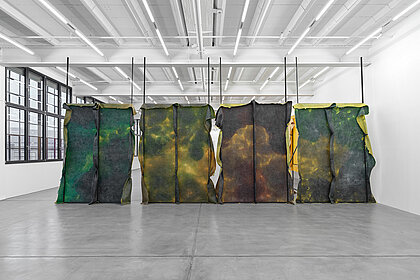
Raff’s Crushes are some of her most painterly works, revealing diverse nuances in the incident light. Soft latex encounters the hardness of metal. The word Crush carries a double meaning – it can be both an infatuation and, as a verb, to overpower or subdue. To create this work, in her studio Raff spread the liquid tinted latex over the floor in several stages and poured it into the contours of a large clay frame made by hand. After they had dried, the pigmented latex sheets were clamped into a metal frame, displaying the flowing and drying processes in fragrant clouds of colour. The flowing colour fields are defined by small air bubbles and uneven sections that shift between opacity and transparency, so that the material can be experienced in its maximum vitality

Courtesy

Image Credits

Den 1 (2024), Den 2 (2024) Den 3 (2025), Den 4 (2025)

Liesl Raff

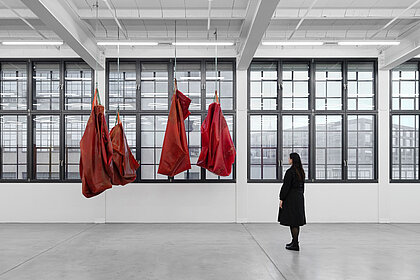
The four Dens hang from the ceiling like velvet pouches, softly folded mantles. For this work, Raff has dyed the smooth latex material completely, so that the red pigments make the latex opaque. Combined with ropes in latex casting, the pouches provide an image of protection and warmth inside. The gentle shimmer of the oil applied to the surface, keeping the Dens supple, produces a physical mirror situation of soothing comfortThe four Dens hang from the ceiling like velvet pouches, softly folded mantles. For this work, Raff has dyed the smooth latex material completely, so that the red pigments make the latex opaque. Combined with ropes in latex casting, the pouches provide an image of protection and warmth inside. The gentle shimmer of the oil applied to the surface, keeping the Dens supple, produces a physical mirror situation of soothing comfort

Courtesy

Movies

Film footage of original performance

Image Credits

Domestic Sanitation, Latex Glamour Rodeo, 1976 Bargain Bed Bonanza, 1976

Helen Chadwick

For her BA degree show Chadwick created Domestic Sanitation, a performance, installation and video which begins with Chadwick and three friends wearing costumes (now lost) created by painting latex directly onto their skin. In these costumes the foursome engage in a bawdy, satirical and feminist play of cleaning and grooming one another, to a soundtrack of Donny Osmond and American advertising voiceovers. In a second act, Bargain Bed Bonanza, the same women are dressed in costumes that are hybrids of beds, mattresses, blankets, women’s bodies and lingerie – part-clothing/part-furniture. They take turns to enact farcical scenes that reflect the character of their costumes; cleaning, playing and teasing. A video of both acts exists while only the ‘bed’ costumes survive, notable for their meticulous hand-stitching. While creating this work, Chadwick wrote her dissertation ‘Vulgarity in the Fashion of the 1960s’, which scrutinised the relationship between fashion and society through the perspectives of taste, body politics and sexuality. 


Credits: 

Film footage of original performance

Courtesy Leeds Museums and Galleries (Henry Moore Institute Archive of Sculptors’ Papers)

Image Credits

In the Kitchen, 1977

Helen Chadwick

Chadwick’s 1977 MA degree show brought both attention and acclaim. Titled In the Kitchen, for this performance and installation Chadwick created a series of wearable sculptures that resembled various household whitegoods: a fridge, an oven, a washing machine. These ‘costumes’ – part-clothing/part-furniture – were constructed from metal frames with soft white PVC outers. Chadwick, alongside several of her classmates, wore the costumes for live and videoed performances combining movement, singing and spoken word with a soundtrack of collaged daytime radio segments aimed at housewives in the background. Through combining women’s bodies with kitchen appliances, similar to Austrian Birgit Jürgenssen (Hausfrauenküchenschürze, 1975) and US-American Martha Rosler (Semiotics of the Kitchen, 1973), Chadwick stressed stereotypes of domesticity. The structures naturally restricted the women’s movements, forcing them to become mechanical and at times involuntary, while the appliances softened, anthropomorphised – the hob rings resembling breasts and the washing machine door looking like a pregnant tummy. 


Credits: 

Film footage of original performance

Courtesy Leeds Museums and Galleries (Henry Moore Institute Archive of Sculptors’ Papers)

Image Credits

Train of Thought, 1978

This performance was created during a period when Chadwick was interested in political and sociological struggles, bringing elements of reality into the gallery space, such a train carriage here, and the cubicles of a social security office in Model Institution (1981–83). Train of Thought explores ‘conflict between strangers … The way a female might react inwardly to a male on the Tube. It was very much a sexual arena – harassment a-gogo. The way a kind of formal public place like a Tube train can suddenly precipitate into a very intimate, disturbing contest’ says Chadwick.


Credits: 

Film footage of original performance

Courtesy Leeds Museums and Galleries (Henry Moore Institute Archive of Sculptors’ Papers)

Image Credits

Making of Carcass for Of Mutability at the ICA, 1986

The video shows the making of Carcass as a part of the exhibition installation Of Mutability at the Institute of Contemporary Arts (ICA) in London in 1986. In the video, Chadwick talks about the process behind this multi-layered work.


Credits: 

Documentation video

Courtesy Leeds Museums and Galleries (Henry Moore Institute Archive of Sculptors’ Papers)