Eva Schlegel. Falling up

How do we perceive space and what happens when our familiar ideas of orientation and boundaries begin to shift? The exhibition Falling up by Eva Schlegel explores the relationship between space, perception, and immateriality. Through photographs, sculptures, mirror works, videos, and augmented reality projects, the artist creates in-between spaces where the familiar suddenly appears different. The paradoxical title Falling up points to a shift in perspective: what may initially feel like a loss of orientation can also open up new ways of seeing.

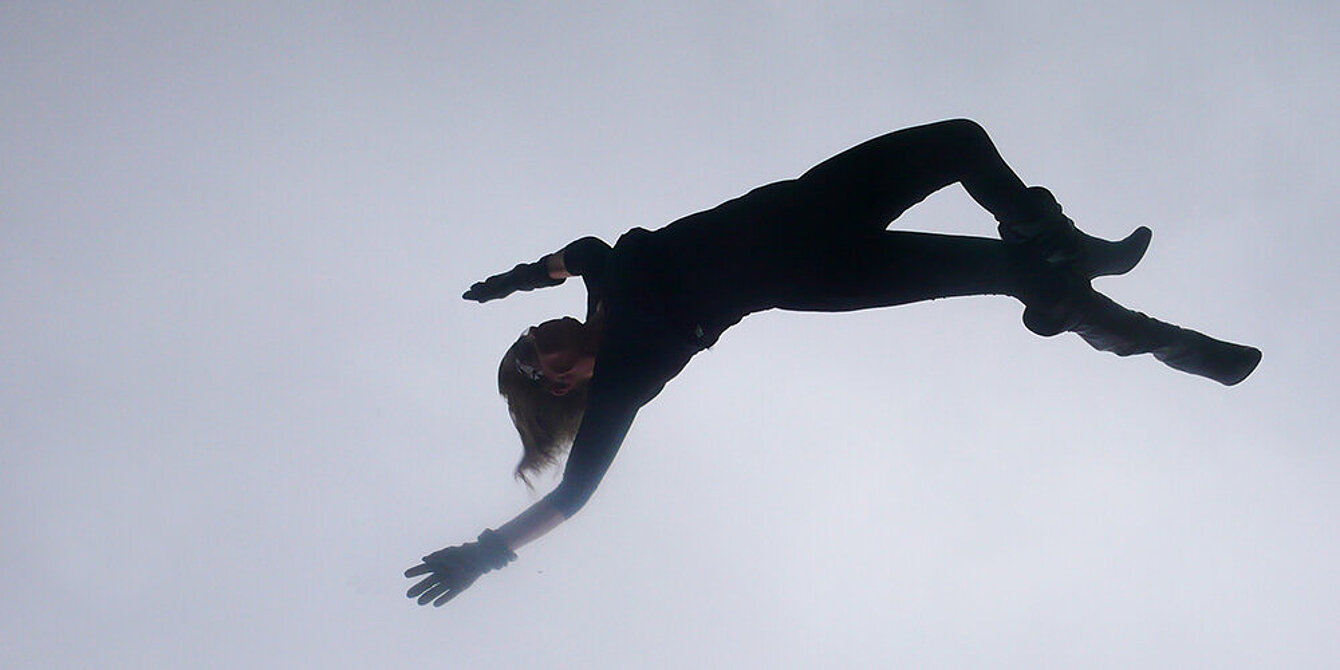
The silhouette of a woman, depicted in landscape orientation, appears to be floating or falling through the gray sky.

Image Credits

What happens when we lose the ground beneath our feet and change our perspective?

The solo exhibition Falling up by Eva Schlegel (born 1960 in Hall in Tirol) explores the relationship between space, perception, and orientation. Through her works, Schlegel opens up new perspectives on how we experience space, challenging familiar boundaries and certainties.

Works in the Exhibition

Image Credits

Floating orbit, 2026

Eva Schlegel’s Floating orbit slowly rotates around its own axis. Its highly polished steel rings show ever-shifting sections of the surroundings. Fragments of the space are multiplied and expanded in the reflections, while our own image remains largely concealed. With every rotation of the revolving work, the space is reconfigured. Our familiar act of self-recognition in the mirror recedes, allowing a more intense perception of the space.
 

In this way, Floating orbit introduces a central theme in Eva Schlegel’s practice: for her, space is not a fixed constant but something that continually changes through perception, movement and our own position. Her works destabilise familiar spatial orders and question how we orient and situate ourselves in space.
 

The title also suggests movement: an ‘orbit’ describes the path of a celestial body determined by gravity. ‘Floating’, on the other hand, evokes a state of hovering or drifting – seemingly free from gravity and any firm hold. Schlegel brings together two states that appear contradictory, opening up a space of in-betweenness.

Image Credits

Ikarus, 2023; Falling up, 2026

Flying/Falling/Floating Women and Men

Our longing to be able to fly finds an early expression in the myths of ancient Greece. The tragic story of Daedalus and Icarus tells of the desire to overcome gravity and transcend the limits of human nature. The dream of flight comes to an end when, in a moment of hubris, Icarus flies too close to the sun and plunges into the sea.
 

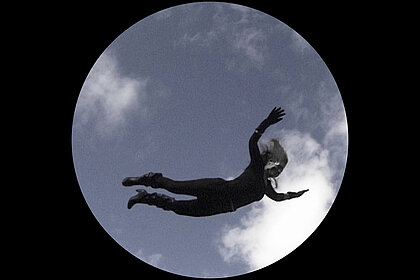
Inspired by Yves Klein’s famous photo Leap into the Void (1960), Eva Schlegel initially had a man wearing a tuxedo jump into a lake three times from a height of seven metres. Later, in Zurich, she worked with professional bodyflyers dressed in everyday street clothes. In free fall or floating, we encounter the illusion that perhaps comes closest to flying.

Image Credits

Liminal spaces (2022, 2026)

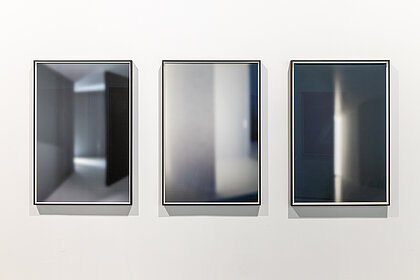
Eva Schlegel’s Liminal spaces show architectural spaces of transition and threshold. The title refers to liminality, a concept that originated in ethnology and which describes the intermediate phase of rites of passage – the moment when an old status has already been left behind, but a new status has not yet been reached. The term is also used in gaming culture to describe spaces that are generated entirely digitally. The Liminal Spaces convey a moment of being in-between, of standing on the threshold. Schlegel’s spaces become sites of potential change, raising questions about orientation and belonging.
  

The works begin with models of spaces, which she photographs under different lighting conditions. Schlegel’s next step is to determine a particular degree of blurring for each motif. In the process, details are lost and clear spatial references dissolve. At the same time, new visual and atmospheric impressions emerge. The spaces appear more sensual and less real, both strange and familiar. The interplay of visibility and concealment opens up a space that allows viewers to explore associations. This space seems full of possibilities, yet simultaneously highlights its own limits.
 

In her more recent works, these Liminal spaces become increasingly unstable and burst into flames. Fire and smoke show the moment just before destruction. Over and again, social and political orders also find themselves approaching such thresholds – whether these herald danger or hope. How an uncertain situation will unfold is a question that remains open: coup or revolution?

Image Credits

o.T., 1999

Blurred texts on glass (first presented in 1993)

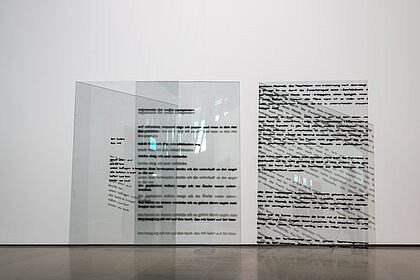
Human-sized glass panels lean against the walls like loose pages of a book – one that is, however, impossible to read. The silkscreen-printed texts, based on material drawn from Eva Schlegel’s library, have been photographed out of focus to the point of illegibility. Although we cannot make out individual words or decipher their meaning, we immediately identify them as texts. Perhaps we can even guess what kind of texts they are. 
 

Blur has been a recurring principle in Eva Schlegel’s work since the late 1980s. Her blurred texts examine the process of reading and the limits of our perception. What remains of a text when it no longer conveys information? Do we still see a text, or has it now become an image? Their illegibility at first frustrates us, and yet it also sharpens our attention. Instead of grasping the content, we begin to perceive writing in a different way: its structure, density and arrangement. It loses its fixed meaning and becomes the starting point for something new.  

Image Credits

ohne Titel (114 silber), 2018, o.T. (134), 2015; o.T. (162), 2008; o.T. (163), 2008

(Cloud Image)

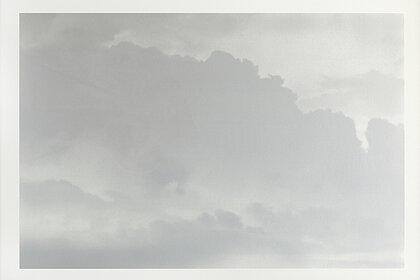
Eva Schlegel’s cloud images are based on snapshots taken from a car during her travels. In this way, a passing glance at the sky becomes the starting point for a prolonged exploration of its shifting forms. Schlegel translates these photos into different media: clouds appear as silkscreen prints on both lead and handmade paper.
    

Clouds may remind us of landscapes, bodies or unknown shapes, and can look completely different from one moment to the next. The longer we look, the less sure we are of what we think we recognise. It is this tension that interests Schlegel: in our perception, the cloud appears as something wholly tangible, and yet as a form it is also abstract, fleeting and constantly changing. The scale of the works also plays a role here – as Schlegel puts it: ‘I want to be able to lose myself in the sky.’

Image Credits

o.T., 2009–2013

(Flying/Falling on Lead)

In Schlegel’s lead works, we once more encounter the flying and falling figures. This time, their movement seems frozen, and yet it is still unclear whether the bodies are rising or descending. Schlegel translates the photos into silkscreen prints on lead.
 

As a material, lead embodies a number of contradictions: it is heavy, yet soft and malleable; it can protect us against radiation, but is itself toxic. Schlegel describes lead as a ‘melancholic material’. Its heaviness and durability stand in contrast to the lightness and movement of the bodies depicted.
 

Schlegel sets the lightness of flying against the heaviness of the material, and so visualises the ambiguity of falling. It can mean freedom and letting go, but also failure. ‘When I have an idea (…), I start flying in my mind,’ Schlegel says of the moment when you do not yet know ‘whether it will succeed, or whether you will crash’. Schlegel embraces failure as an integral part of her artistic process that can provide the impetus for something new.
    

Image Credits

In between, 2010

Eva Schlegel projects images of people training at a free-fall training centre onto two aircraft rotors that appear to be floating in space. They are interspersed with birds, weather balloons and Newton’s falling apple. Combined with their rhythmic sound and the airflow they produce, the monumental rotors allow us to experience both the fascination of flying and the danger of falling on a physical level.   
 

Quotes from astronauts and cosmonauts sweep across the rotors in circles and spirals. They speak of weightlessness, of losing your grounding, and the search for a fixed point of reference. A smaller third rotor in the space emits a red signal, transforming a quotation into Morse code and suggesting an attempt to establish contact from afar. The title In between describes this state of being suspended: between up and down, gravity and weightlessness, flying and falling. When familiar points of reference disappear, it becomes almost impossible to work out which way the body is moving.

Image Credits

See the invisible, 2016

Eva Schlegel / Barbara Imhof / Damjan Minovski

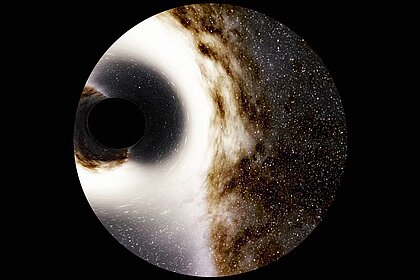
In See the invisible, Eva Schlegel takes us on a journey through space, past the Milky Way, black holes and distant galaxies.  Lasting just under seven minutes, the film was developed in collaboration with space architect Barbara Imhof and computer specialist Damjan Minovski.
 

It is based on SpaceEngine, a computer simulation that combines known astronomical data with computer-generated views of the universe, offering us a glimpse of phenomena and dimensions that would otherwise be invisible to us.
 

At the Kunsthaus Graz, See the invisible is projected into the Schlossberg Nozzle and so integrated into the architecture of Space01. This opening usually looks out onto the clock tower from the ‘Friendly Alien’. The familiar landmark has been replaced by a view of outer space, and so also a view of the past, since the light is only now reaching us from distant celestial bodies that have long since ceased to exist.    

Image Credits

Cloud, 2026

Eva Schlegel / Valerie Messini

The mirrored Clouds are seating elements designed especially for this space by Eva Schlegel in collaboration with exhibition architect Valerie Messini. Arranged in loose clusters, their circular shapes make us think of clouds. The form of the circle recurs throughout Schlegel’s work: like a hole or a telescope, it can open up a view into other spaces and realities.
 

Visitors are invited to take a seat on the mirrored surface and themselves experience a sense of floating – much like the flying and falling figures in the surrounding works. The reflections also draw the exhibition space into the artwork. Depending on our viewing angle, it is multiplied, fragmented and distorted. Familiar spatial boundaries waver and shift, and for a moment the space seems to extend beyond itself.

Image Credits

Dance of chance, 2025

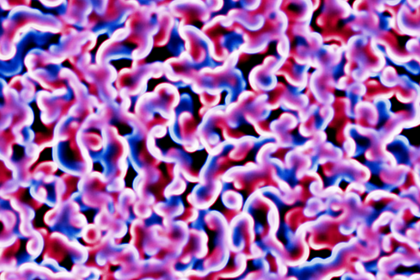
The points of light on the narrow LED strip, which follows the S-shaped curve of the room, constantly form new patterns. They are based on a mathematical model developed by the British mathematician Alan Turing. In 1952, Turing described how, through the interplay of reaction and diffusion, complex structures can emerge from what was initially an almost uniform state. Small random variations can be amplified during this process, influencing where individual shapes emerge. These ‘Turing patterns’ are used today to help explain the stripes and spots found in nature, such as those on the coats of giraffes and zebras.
 

Eva Schlegel translates this principle into a moving image. Dance of chance moves between regularity and unpredictability: small changes continually produce new patterns and forms. The work also creates a connection between the inside and outside space of the Kunsthaus. After dark, a modified version of the artwork appears on the BIX media facade, bringing the Dance of chance out into the city.

Image Credits

Bubbles, 2026

Image Credits

Layered view, 2026

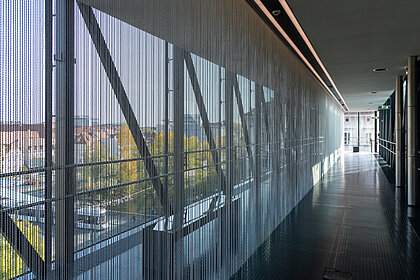
Up in the Needle, Eva Schlegel disrupts the anticipated view of the historic old town of Graz with a 40-metre-long curtain of steel balls. Depending on where you are standing, this can appear as a translucent veil or condense into an almost solid wall. Once again, the apparent certainty of the image we see is called into question. We are invited to walk through the curtain and experience the city gradually coming back into focus before our eyes. 


Eva Schlegel reminds us that perception is not a constant. What we see, and how we see it, changes with our position and movement in space. Sometimes, a simple shift in viewpoint can be enough to make a familiar image take on a new form. And so the exhibition does not conclude with one definitive view, but instead invites us to continually renew our own way of looking.