





Image Credits
Date
23.09.2026
Time
5pm - 6pm
Location
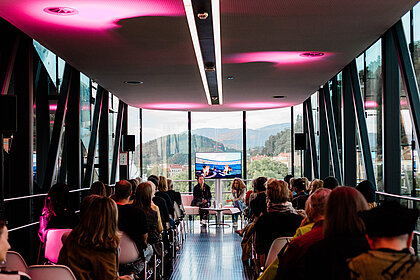
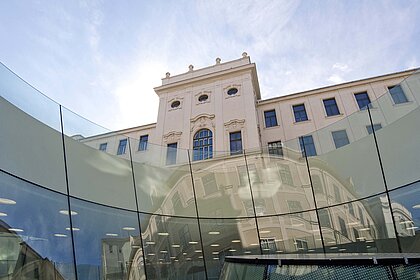
Kunsthaus Graz, Space04
Costs
Free admission.
Show all
Oksana Kazmina is an artist, filmmaker and performer. In her works, she questions the relationship between body* and media, the mediality of experience and embodied memory. Oscillating between macro and micro – perspectives and (male) ‘gazes’ – Kazmina explores how we look at things, at the other, at female* bodies and frankly at the other which is being a woman in patriarchy.
Since Russia’s full-scale invasion of Ukraine, her artistic practice has also focused on aspects of ‘un-archiving’. Her ongoing process challenges the notion of an archive as a female artist who is constantly on the move and absent, whilst her home is being erased. At the same time, it is an exploration of memory as a selective process that depends on places and other people.
Contemporary History of Ukraine is Kazmina's ongoing artistic project that takes different shapes depending on the context and is mediated through various forms and agents including bacteria, microscopy and performance; she has been working on it continuously since 2022. It is an unarchiving effort and sensory manifestation of certain inter- and intrapersonal experiences that manifests itself in various media and forms – such as video, bacteria or performances – depending on the artist’s location and context.
During her residency in Graz, Oksana Kazmina will continue to write this story through a series of performances. Here, she will study ‘objects of memory‘ through the series of participatory performances: Encounters will focus on the absence and on the unknown as the constitutive condition of the memory.
Further performances:
30.09., 18:00, in the context of the Office for Ukraine OPEN HOUSE, < rotor > Zentrum für zeitgenössische Kunst
14.10., 18:00, ZIEGEL. Atelier Gemeinschaft ukrainischer Künstler*innen
21.10., 18:00, tbc
Oksana Kazmina is part of the cine-movement “Freefilmers” (Mariupol/Kiev) and solidarity networks in Ukraine.
This residency is organised as part of BRIDGE, a collaboration between AWARE (Paris), City of Women (Ljubljana) and Kunsthaus Graz, funded under the Creative Europe programme (2026–2028) . The invitation follows the project's aim to actively dismantle intersectional barriers and diasporic identity challenges faced by female-identified artists.
BRIDGE: Building, Revising, Including – Diaspora and Gender Equality is funded by the European Union under the Creative Europe programme.
Supported by Kulturvermittlung Steiermark