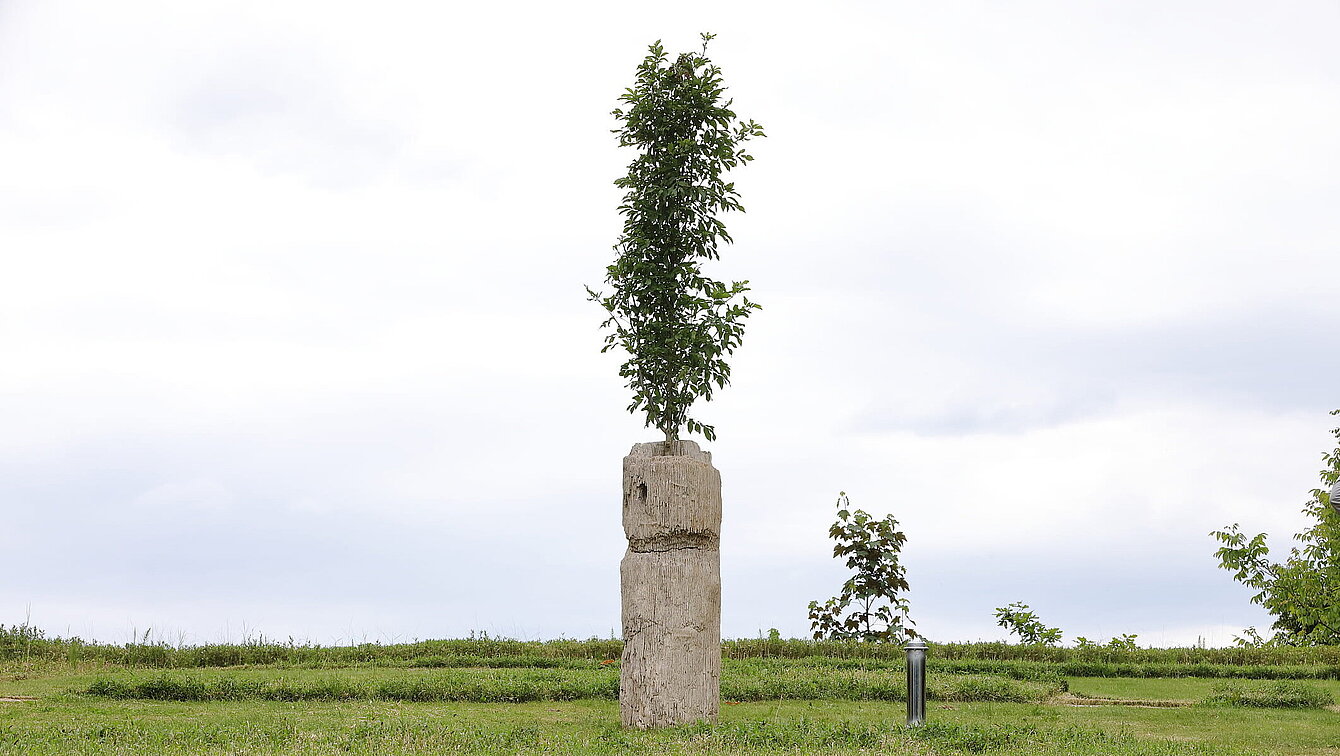
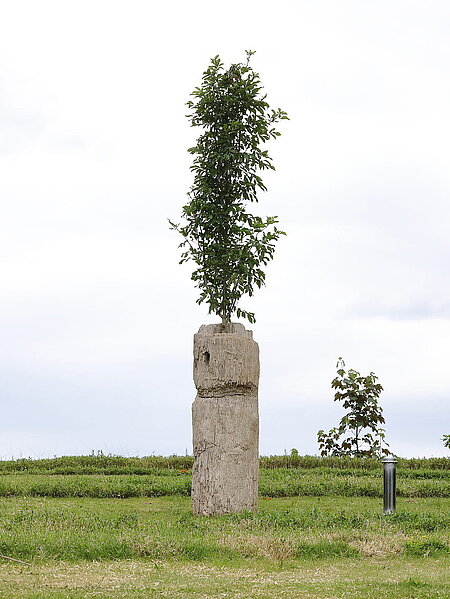
Christian Kosmas Mayer explores the themes of change, development, and evolution from both a cultural-historical and scientific perspective in this work. He often researches historical and contemporary contexts and develops cross-media installations based on this. Central to his work is his fascination with archiving, preserving, and retelling history and memory. He sees not only his time capsule, which he buried together with the mayor of Premstätten as part of the spring festival on May 25, 2025, as an archive, but nature itself. It preserves historical changes as well as long-gone life forms.
Particularly the soil, which preserves not only natural remains but also cultural and historical artifacts, reveals entire epochs of human and Earth history. Diverse traces are left by climate, geological processes, land use, and other influences. For example, a part of the Austrian Sculpture Park’s area was used as a landfill, thus being a striking example of human intervention in nature which influences it over centuries, changing it forever.
Most plants and animals which have existed throughout Earth's history are now extinct or have evolved into other live forms. The key to understanding these evolutionary and geological processes is the so-called Deep Time, as they take place on a different scale of time than processes in human society.
The growth and lifetime of a tree can be seen in its annual rings. Petrified wood is created when mineral-rich water replaces the organic material of a tree trunk over millions of years. In it these annual rings are permanently preserved. For this work, the artist acquired such a specimen from a dealer working closely and fairly with Indonesian craftsmen, who specialize in recovering and processing petrified tree trunks from the Miocene epoch.
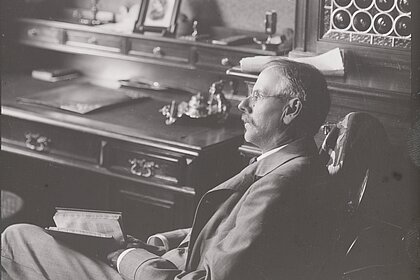
In his processual sculpture, Mayer incorporates ideas from Swiss landscape architect Dieter Kienast (1945-1998), who designed the Austrian Sculpture Park in 1997 as part of the International Garden Show in Graz.
Christian Kosmas Mayer references a specific quote by Kienast and combines it with his own ideas:
“Gardens and parks should not only tell their own stories but also tell new stories. They are poetic places of our past, present, and future.”