



The Styrian Autumn Festival celebrates its 50th anniversary in 2017 under the motto ‘Where Are We Now?’. A central component is the examination of Elfriede Jelinek's magnum opus ‘Die Kinder der Toten’ (The Children of the Dead). The action of this play takes place in the poet's birthplace, in the Styrian Mürztal valley.
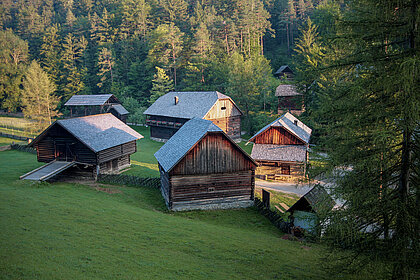
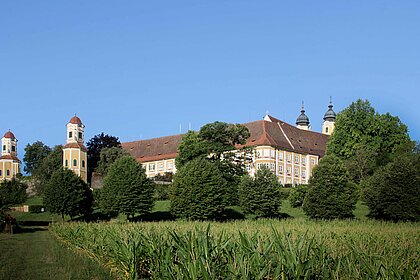
Referring to Austria's repressed war and post-war history, the effects of which are still evident today, Jelinek draws rhizomatic connections in her texts between the undead, unprocessed matrix slumbering in the depths and always ready to erupt, between guilt and omissions in history, and the oppressive, gorge-like forest and mountain landscape criss-crossed by water. Influenced by Catholicism, this landscape includes a cathedral in Neuberg and Mariazell, Austria's most important place of pilgrimage. In 1869, Emperor Franz Josef built a hunting lodge in Mürzsteg, which has served as a summer retreat for the incumbent Federal President since 1947.
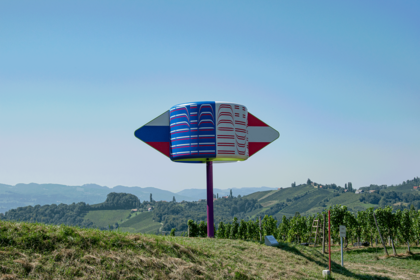
As part of its collaboration with steirischer herbst, the Institute for Art in Public Space Styria invited Marko Lulić to create a temporary installation in the Mürztal valley. This unique region, with its political, ecclesiastical and industrial history intertwined with extreme yet formative natural, climatic and weather conditions, has long been a focus of the Institute's attention. Lulić was selected because he combines the question of social values with profound social upheavals and is dedicated to the ideological heritage of modernist design language in Eastern and Western Europe.
His work is characterised by an examination of history, identity, architectural and sculptural symbolism, language and its reformulation or redefinition. The historical turning point of 1989, the global liberalisation of markets, and the strong de-secularisation movements following the Balkan War also repeatedly find their way into his projects. Typography and monuments in public spaces play an important role in his work. Based on formal investigations of cultural, social, and political themes, layers of meaning are revealed through carefully placed interventions. With the help of material meanings and shifts in size, he repeatedly liberates ideologically charged symbols from their usual function, exposing their political model character and making them readable in various ways at a stroke. In addition to the image and character systems that shape our public world, the body plays an equally important role as an object of inscription and a necessary reference point for perception.
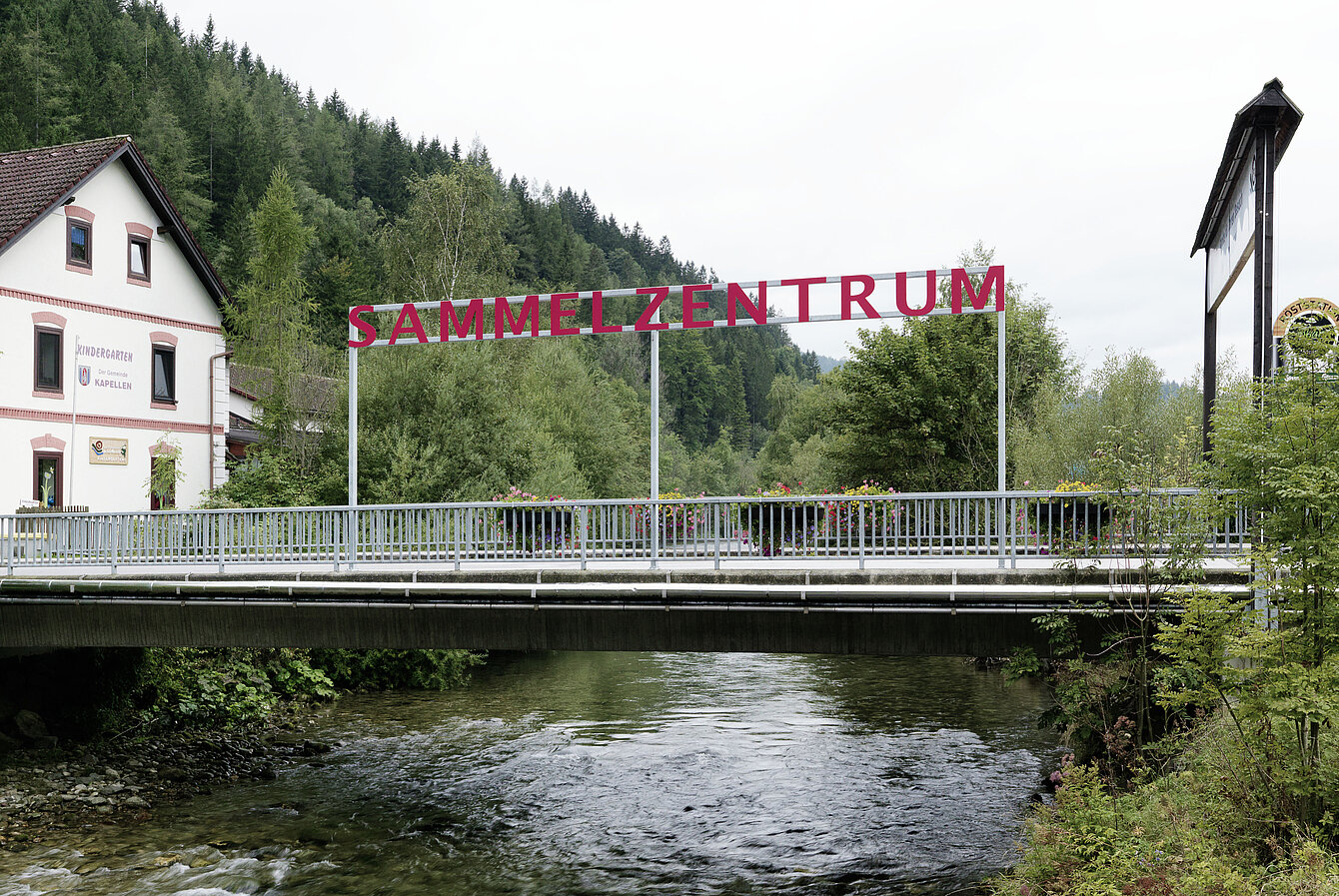
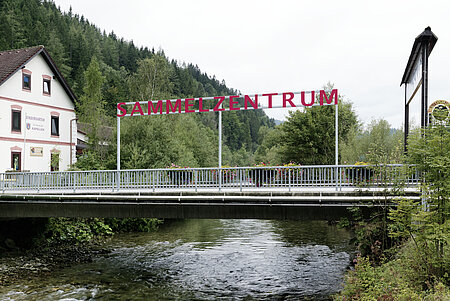
For his sculptural installation, he chose the Neuberg district of Kapellen, which is also the centre of steirischer herbst. Eschewing the heaviness and almost unreadability of Jelinek's writing style, he researched the novel, the local environment and history in order to create a visible, multi-layered and ambiguous sign.
Due to the varying interconnections between these levels, we are exposed to perceptual discrepancies that we cannot escape: we perceive work as widely visible information, we are attracted to it, yet at the same time it reminds us of prescribed commands that must be obeyed and instructions for maintaining order. Linguistic abbreviation of content, we see only one term, in favour of the striking, reminiscent of populist directives that demand order and do not allow contradiction. In the ambiguity of the term, we also recognise the hidden danger of concealing actual plans that cannot be discerned. SAMMELSTELLE appears to be a common, everyday term, also used locally to refer to a rubbish collection point, but in its setting it also refers to a centre of the Styrian autumn, a meeting place; on the other hand, in its aesthetics and positioning in camouflaged form, it is also reminiscent of departure points for the deportation of people deemed worthless during the Second World War with the intention of never letting them return. We also associate this setting with the enforced concentration of refugees whose future lives are completely uncertain. This oscillation between anchor point, lurking danger and uncertainty accompanies and sensitises us and characterises the work.
Elisabeth Fiedler and Dirck Möllmann
