In an individualised world characterised by constant competition, it is necessary to conceive and establish new points of reference, intersections and multiplicities. This question of the ‘we’ of a shared, vibrant public sphere is more important than ever, given that those social forces that understand this ‘we’ as exclusive and largely unchangeable are laying claim to its definition. Yet the question of commonality is not easy to answer in a reality marked by social fragmentation, growing wealth disparities and migration.
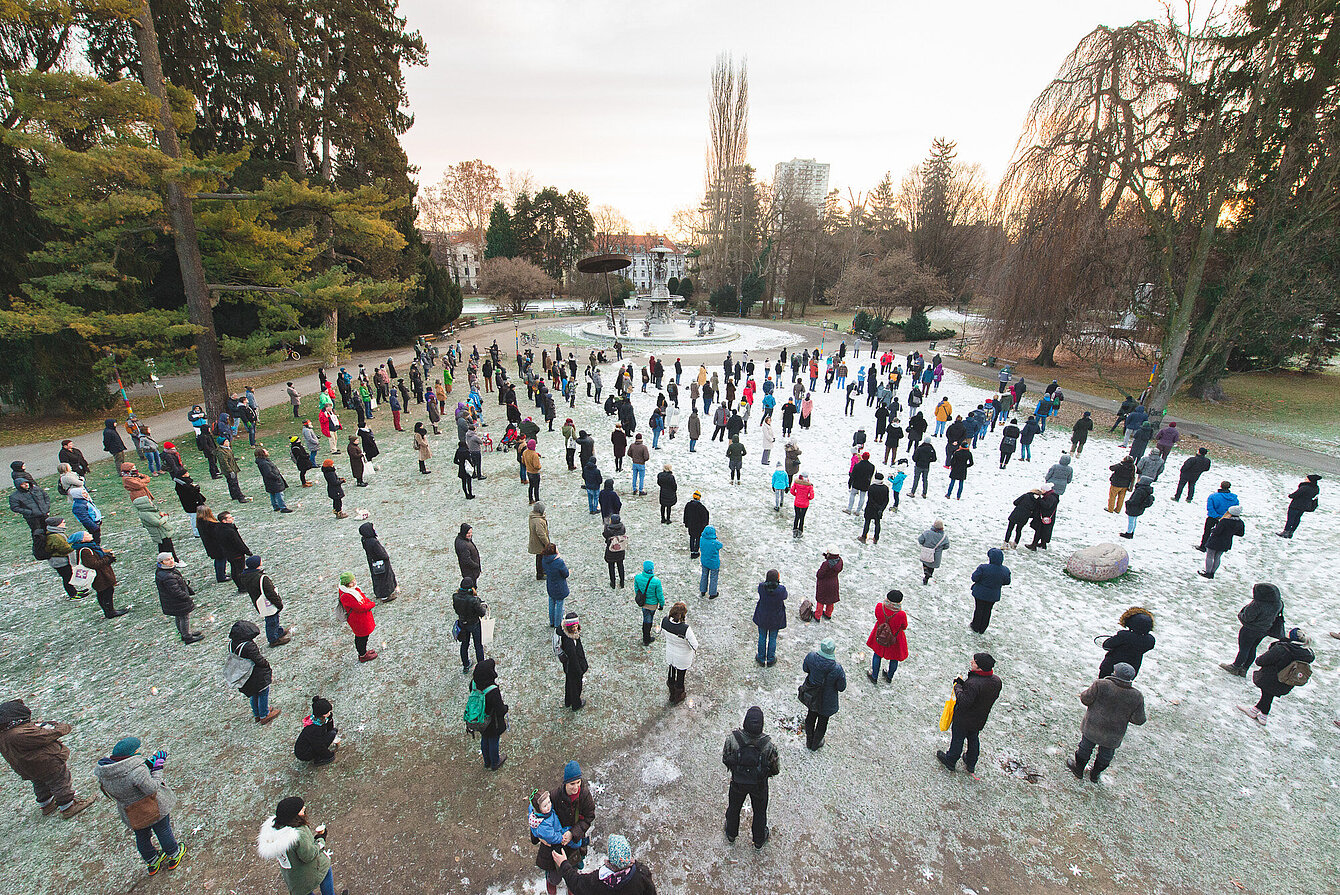
The project ‘feldstellen* PRÄSENZ DER VIELEN’ (field positions* PRESENCE OF THE MANY) is an attempt to make such diversity visible for a moment: a gathering under the credo of humanity. The artistic and creative intervention lies in the form of the installation. Marked on the ground by a multitude of different light sources, a field of light is created in the darkness. Arranged in a triangular grid with a distance of 1.8 metres between each light, everyone in the field has enough space for themselves. At the same time, there are six people within reach to establish a connection, if desired. Together, this creates a kind of ‘social sculpture’ in the literal sense, based on the shape of a honeycomb. The early hour and the expected cold make the statement of standing together a determined gesture: overcoming oneself once, in the name of human rights.
The performance is very minimalistic. After a welcome by initiated ‘godparents,’ everyone finds their place. Then it's all about nothing more and nothing less than the shared experience of an everyday but also very hopeful moment: sunrise. Sound sources are distributed throughout the space, creating a soundscape at the exact moment of sunrise at 7:33 a.m., making the sun perceptible even in foggy conditions. Then it becomes quiet.
Following this mixture of artistic happening, political manifestation and public ritual, we invite everyone to breakfast and the gathering dissolves into conviviality.
Participating artists:
Nayari Castillo, Franziska Hederer, Robin Klengel, Margarethe Maierhofer-Lischka, Heidrun Primas, Helene Thümmel, Clara Wildberger and Nikolaos Zachariadis.