


Dellbrügge & de Moll

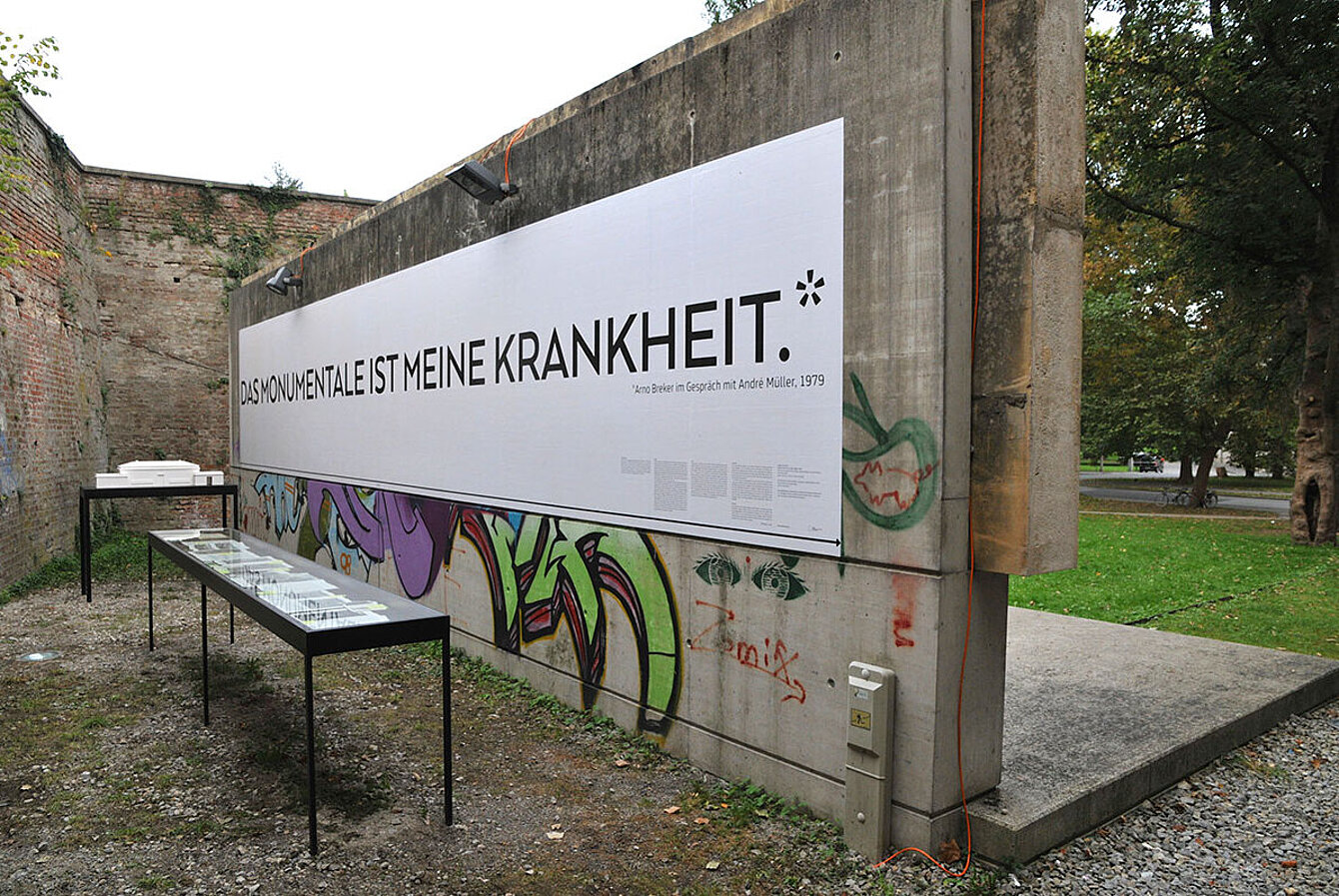
THE MONUMENTAL IS MY MALADY.*

18.09. - 18.10.2015

Image Credits

Duration

18.09. - 18.10.2015

Opening

Friday, September 18, 2015, at 4 p.m.

Meeting point

Behind the memorial for the fallen of both World Wars by Alexander Silveri at Paulustor, 8010 Graz

Costs

free entry

Show all

About the
Project

*) Arno Breker in conversation with André Müller, 1979, 18.09.2015 - 18.10.2015. Dellbrügge & de Moll question the relationship between art and power. In Graz, once a „city of national uprising,“ they strike a point of resonance. As a starting point serves the case of the former Nazi state atelier of Arno Breker in Berlin, where they themselves worked from 2001 to 2009. The sculptor Arno Breker had been commissioned with the design of monumental sculptural works for the planned Nazi world capital Germania - a fact which catapulted Breker, a protégé of Hitler, into the role of the best paid and most famous sculptor of his time. According to the Führer’s wishes, a representative state atelier was created. There, the newly appointed decorator of power translated National Socialist ideology into an iconographic program.


The event is part of the Architektursommer 2015.
Sponsored by: Kulturverwaltung des Landes Berlin

Further information

Performance:
18.09.-02.10.2015, daily at 16:00pm

Additional dates: 
18.09., 19.09., 21.-25.09. and 27.09.-02.10.2015, daily at 16:00pm
Verena Lercher on Hitler, Goebbels, Breker, Ideologues and Art Historians of the Third Reich
20.09. and 26.09.2015, at 16:00pm
Rudi Widerhofer on Arno Breker with André Müller,1979.
Elena Trantow as André Müller

Publication:
Dellbrügge & de Moll
Das Monumentale ist meine Krankheit.
Publisher: Elisabeth Fiedler, Dirck Möllmann Institute of Art in Public Space Styria, Universalmuseum Joanneum, Graz 2015
ISBN 978-3-902-09575-2
10 EUR

Continuities

Following the collapse of the Third Reich, why did the Berlin magistrate provide its east wing to Breker’s master students of all people, even indefinitely? Was his dissociation of his professor and sponsor, as well as his turn towards Modernism career-motivated? Why had he inscribed himself under Breker in 1938 particularly? Was the remodelling of the Nazi building into eight individual ateliers in the 1970s an anti-monumental gesture? Was the assignment of its interior for the use of a number of international artists an attempt at political decontamination? Why was the context of the building’s genesis forgotten? And why did Berlin end the atelier program in 2011?

The widow of the master student started a foundation in 1996. Following her initiative and against the protest of artists, Breker’s state atelier was remodelled into an exhibition space for the works of his master student. In June 2015, it was thus reopened as „Kunsthaus Dahlem“ in the style of a monumental studio. This process motivated Dellbrügge & Moll to investigate the Nazi roots of the building.

Location

Behind Alexander Silveri’s memorial for the victims of both world wars by Graz's medieval ramparts opens a narrow room which cannot seen into from the location of the park. There, facing the back of the memorial, the artists document their investigations. The memorial functions as a tension-filled frame of reference. Its 2013 translocation from the historic crown of the city at the Karmeliterplatz to its new home outside of the ramparts represents how history can be overwritten in the present: History is a perpetually incomplete construct. Art in public space visualizes conflicts surrounding the sovereignty of interpretation.

Voices

Actors will take the words of Breker, Hitler, Goebbels and other ideologues and enable listeners to experience the art discourse of the Nazi period. What kind of political dimension was then ascribed to art? Acting out the texts and hearing them spoken aloud allows for a careful critical approach.

With the support of