


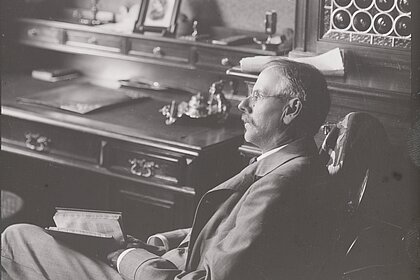





As early as 1904, August Musger, a priest and physicist born in Eisenerz in 1868, submitted a patent for a ‘serial apparatus with a mirror wheel’. This global innovation was able to record in slow motion. The construction of a prototype was delayed due to Musger's financial difficulties, causing him to give up his patent in 1912. Therefore, Hans Lehmann (Ernemann company, Dresden) who took up Musger's patent is regarded as the inventor of slow-motion technology today.
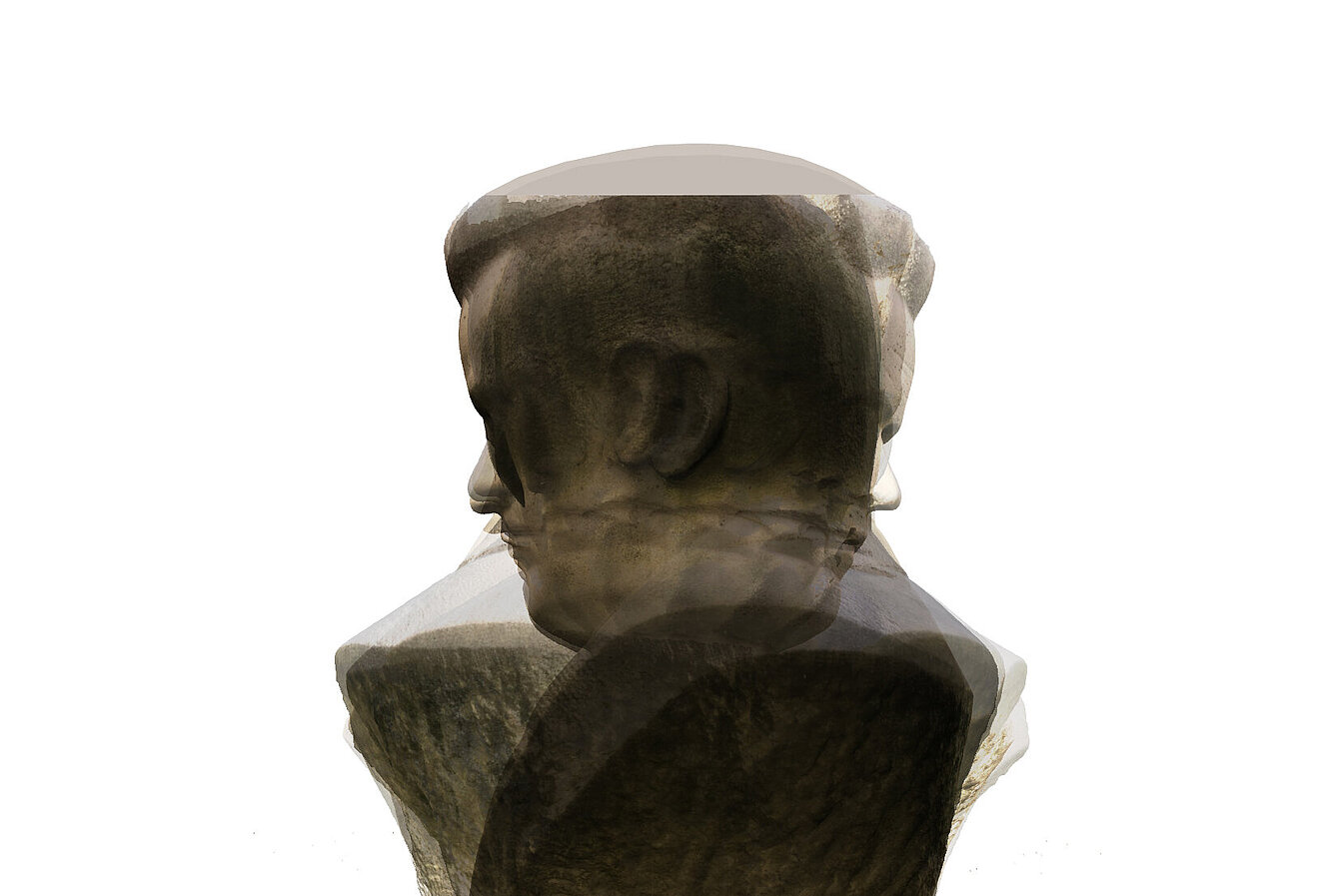
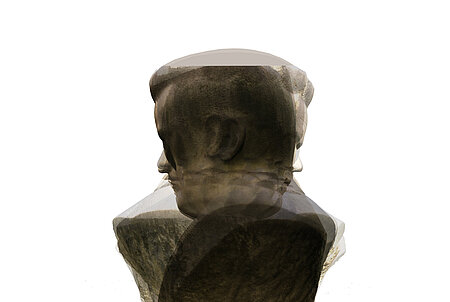
In 2016, Graz-based architect and artist Clemens Luser won the competition for a contemporary monument honouring the original inventor of slow-motion technology. In 2018, the 150th anniversary of his birth, Luser presented a life-size 3D replica of Musger's portrait bust, which has been part of the ‘Styrian Gallery of Honour’ in the Graz Burghof since 1959. He staged the reproduction on a plinth under glass in a traditional manner. It turns out to be a true monument to speed, however, as it can be accelerated at the touch of a button, to such an extent that the rotating head becomes barely visible under a veil of perception.
The rotation is too complex for the human eye, the head appears blurred, anonymous, alienated. Only by using Musger's technique – a slow-motion function via smartphone, tablet or digital camera - can the rotation be slowed down so that the face becomes recognisable again.
Luser's mechanical-kinetic object corresponds to Musger's technical working method. His concept assumes that slow motion requires speed in order to be fully effective, staging a game with the viewer's perception.
The bust was officially opened in 2018 to mark the 70th anniversary of Eisenerz becoming a town.