|
|
|
|
|
|
|
|
|
|
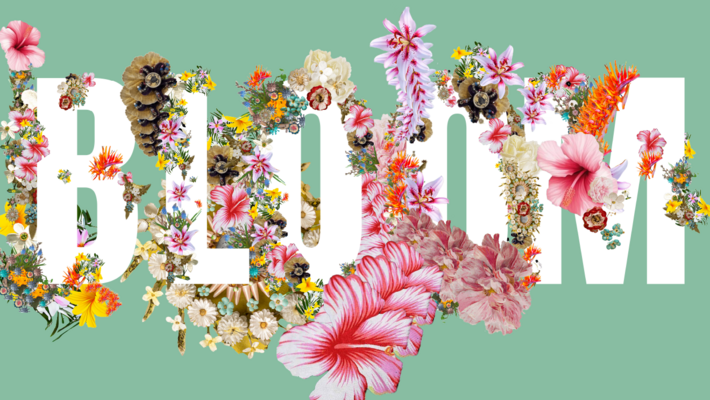
Die Blume wird begehrt, geliebt und gehandelt. Sie gilt als Zeichen des Friedens, der Fragilität des Lebens und der Aufklärung. Diese und weitere Facetten sind der Ausgangspunkt für das Universalmuseum Joanneum und das Kunsthaus Graz, um im Jahr 2026 das ganze Spektrum der Blume zu präsentieren.
Im Kunsthaus Graz sind die beiden Ausstellungen 30% Löwenzahn und Hybrid Pleasures. Helen Chadwick Supported by Liesl Raff zu sehen. Herzliche Einladung zur Eröffnung!
Opening: 20.03.2026, 6pm
Flowers are desired, loved and traded. They are seen as a symbol of peace, of life’s fragility and of enlightenment. These facets, and others, form the starting point for the Universalmuseum Joanneum and the Kunsthaus Graz to present the flower in all its facets in 2026.
The Kunsthaus Graz is showing two exhibitions: 30% Dandelion and Hybrid Pleasures. Helen Chadwick Supported by Liesl Raff. Your are cordially invited to the opening!
|
|
|
|
|
|
|
|
|
|
|
|
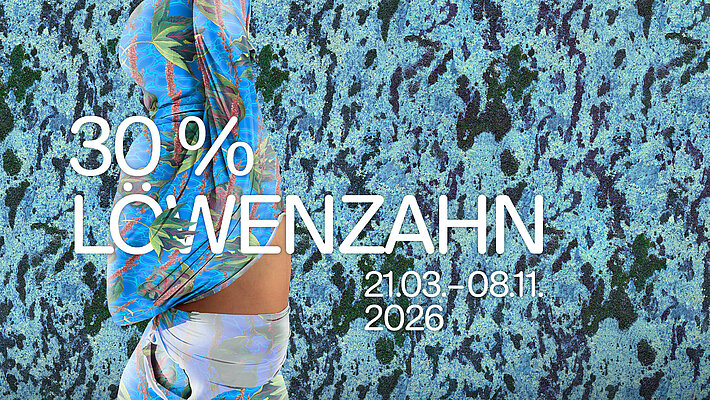
Joiri Minaya, Shield, 2022 © Joiri Minaya
|
|
|
Inmitten ökologischer Krisen, kolonialer Nachwirkungen und digitaler Beschleunigung fordert 30% Löwenzahn neue Formen der Aufmerksamkeit – abgestimmt auf das, was langsam wächst, Zeit fordert und still zurückkehrt. Die Blume an sich, aber auch der Löwenzahn mit seinen sich ausbreitenden Samen, seiner natürlichen Heilkraft und seinem gemeinschaftlichen Gedeihen verkörpert dieses Prinzip einer ethischen Lebensweise der Koexistenz.
Amidst ecological crises, colonial aftermaths and digital acceleration, 30% Dandelion calls for new forms of attention – attuned to what grows slowly, demands time and returns quietly. The flower, but also the dandelion with its spreading seeds, its natural healing power and its communal flourishing, embodies this principle of an ethical way of life based on coexistence.
Mit/With: Iris Andraschek, Suzanne Anker, Andrea Bowers, Viltė Bražiūnatė & Tomas Sinkevičius, Regula Dettwiler, Spencer Finch, Barbara Frischmuth, Genia Holubentsev, Anita Fuchs, Sanja Iveković, Anna Jermolaewa, Markus Jeschaunig, Claudia Larcher, Jonas Mekas, Joiri Minaya, Ryts Monet, Alois Neuhold, Agnieszka Polska, Anna Ridler, Ugo Rondinone, Martha Rosler, Nina Schuiki, Elfie Semotan, Thomas Stimm, Michael Stusser, Neja Tomšič, Sonya Schönberger und Anna Zemánková u. a. sowie Leihgaben aus den Sammlungen des Universalmuseums Joanneum / as well as loans from the collections of the Universalmuseum Joanneum
21.03.–08.11.2026
Kunsthaus Graz, Space02
|
|
|
|
|
|
|
|
|
|
|
|
|
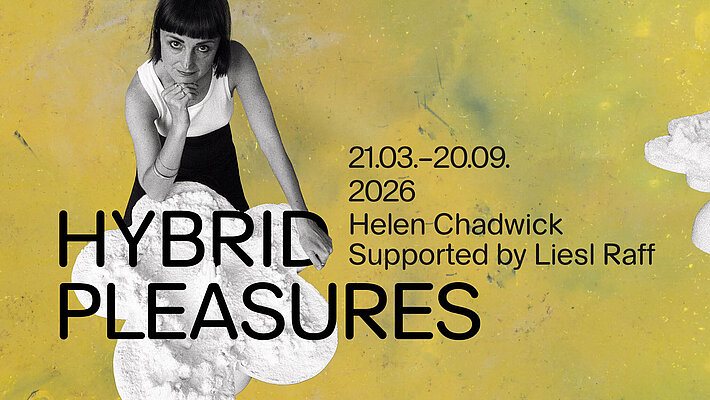
Helen Chadwick with Piss Flowers from the exhibition ‘Helen Chadwick: Effluvia’, Serpentine Gallery, 1994, Photo: Kippa Matthews © Kippa Matthews – Liesl Raff, Crush 3, 2025, Courtesy the artist and Galerie Eva Presenhuber Zurich / Vienna © the artist & Bildrecht, Vienna 2026, Photo: Stefan Altenbuger – Montage: Grafprom
|
|
|
Erstmals seit über zwei Jahrzehnten wird Helen Chadwicks (1953–1996) radikales, sinnliches Werk im ganzen Umfang gezeigt und durch den Dialog mit Liesl Raff (* 1979, Stuttgart, lebt in Wien) in einen aktualisierten Kontext gestellt. Die britische Künstlerin Helen Chadwick spürt in ihren wegweisenden skulpturalen und performativen Arbeiten den sinnlichen Aspekten der natürlichen Welt nach. Immer wieder nimmt sie Bezug auf die Metapher der Blume und des Blühens – und bricht dabei mit Vorstellungen des „Traditionellen“ und eines konservierbaren „Schönen“ in der Kunstgeschichte. In der Ausstellung treten ihre Werke in den Dialog mit der jüngeren Bildhauerin Liesl Raff, deren bildhauerische Praxis sich ebenfalls gegen Stereotypisierung – insbesondere in Bezug auf Material, Architektur und Vorstellungen von Körper – richtet.
Koproduziert mit The Hepworth Wakefield. In Zusammenarbeit mit Museo Novecento, Florence
For the first time in over two decades, the radical and sensuous work of Helen Chadwick (1953–1996) is presented in its full scope and brought into dialogue with Austrian-based sculptor Liesl Raff (*1979, Stuttgart), offering a contemporary perspective on Chadwick’s groundbreaking practice. The British artist Helen Chadwick explored the sensuous aspects of the natural world in her influential sculptural and performative works. She frequently referenced the metaphor of the flower and the act of blooming—challenging traditional ideas of what is considered “conservative” or “beautiful” in art history. In this exhibition, her works enter into conversation with those of Liesl Raff, whose sculptural language similarly resists stereotyping—particularly in relation to material, architectural references and concepts of the body.
Co-produced with The Hepworth Wakefield. In collaboration with Museo Novecento, Florence
21.03.–20.09.2026
Kunsthaus Graz, Space01
|
|
|
|
|
|
|
|