|
|
|
|
|
|
Graz, 30.03.2026
The flower is coveted, loved, and traded. It is regarded as a symbol of peace, the fragility of life, and the Enlightenment. Drawing inspiration from these multifaceted meanings, the Kunsthaus Graz and the Universalmuseum Joanneum present a wide-ranging exploration of the flower in 2026. A total of 10 exhibitions and a diverse program is on offer through November.
The Kunsthaus Graz kicks things off right at the start of spring with a double opening: on display will be the group exhibition 30% Dandelion and Hybrid Pleasures. Helen Chadwick Supported by Liesl Raff.
|
|
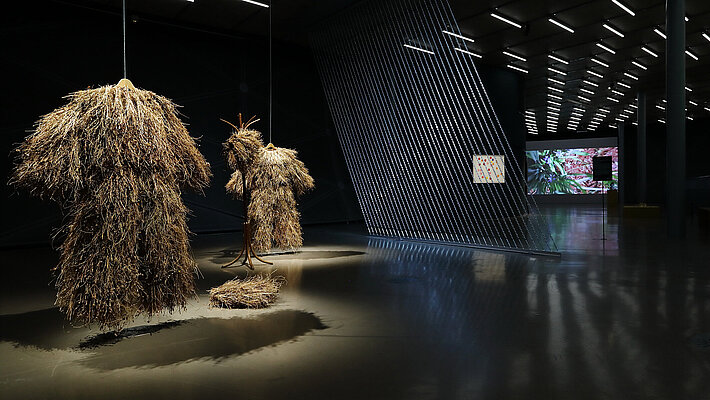
The Kunsthaus Graz is currently hosting two exhibitions centered on flowers. In Space02, the group exhibition “30% Dandelion.” The title refers to our kinship with plants. Photo: Kunsthaus Graz/J.J. Kucek
|
|
|
|
|
|
|
|
|
|
|
|
Our close kinship with flowers
With the exhibition 30% Dandelion, the Kunsthaus Graz presents a tightly woven show from the foyer to the roof: cultural and natural history objects from the collections of the Universalmuseum Joanneum, the Franz Nabl Institute, and various private lenders enter into dialogue with more than 30 contemporary works. The title 30% Dandelion serves as the exhibition’s leitmotif and draws on a statement by the pioneering bio-art artist Suzanne Anker: flowers are one-third related to us. In conjunction with Emily Dickinson’s poem “Bloom” and her call within it for respect for the flower’s great responsibility, an invitation emerges to learn—from this inner connection—to be open, resistant, and at the same time humble.
The exhibition advocates for a new form of porous attention—an attitude attuned to what grows slowly, takes time, and forms community.
A multifaceted exploration of our times
In the face of ecological crises, the lingering effects of colonialism, and the accelerating pace of digitalization, it is all the more urgent to take beauty seriously as a source of insight. Many works in the exhibition call for a shift in perspective:
Anna Ridler’s media installation Circadian Bloom, for instance, invites visitors to step into the flower’s own time: Her “flower clock” makes time tangible as a relative construct, in which blossoms open and close precisely—yet individually—to the rhythm of the sun and the earth. Thomas Stimm’s oversized dandelion, on display starting April 1 on the Graz train station forecourt, as well as his bud at the Kunsthaus, calls for a shift in perspective, bringing the otherwise overlooked plant to eye level. In the treatment of flowers, botanical and symbolic resilience are closely intertwined: Sanja Iveković brings revolutionary songs to the Kunsthaus’s moving walkway, while Anna Jermolaewa shows in The Penultimate how popular resistance uses the flower as an image of personal vulnerability and persistently demands peaceful solutions.
In the works of Iris Andraschek, Agnieszka Polska, and Viltė Bražiūnaitė & Tomas Sinkevičius, the flowers themselves speak out: as sentient counterparts who resist attributions and warn against ecological exploitation. Sonya Schönberger demonstrates how flowers are also linked to global extraction and the reshaping of identity, using the rose trade as an example. Joiri Minaya traces colonial-botanical interconnections—from stereotypes of the “tropical” and the “exotic feminine” to narratives of self-empowerment.
Neja Tomšič also demonstrates such power: she researches Slovenian migrant workers in Alexandria who, in addition to their work as wet nurses, created their own gardens—as spaces of cultural memory and self-assertion.
|
|
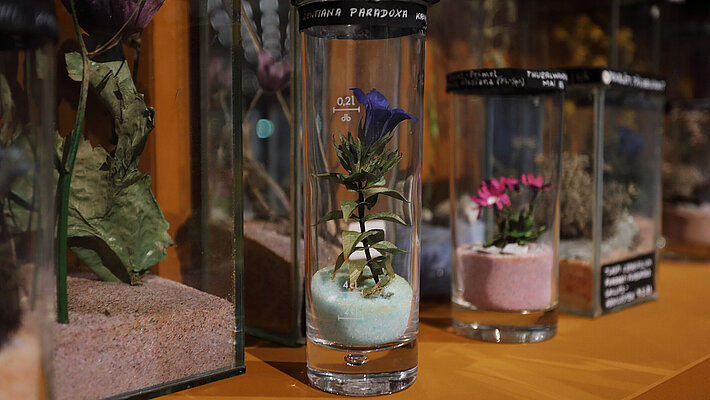
The exhibition features contemporary works and loans from the collections of the Universalmuseum Joanneum as well as from private lenders. The plant collection of Wolfram Hannig (1923–2009) is the result of decades of travel and a deeply personal and labor-intensive collecting practice. Photo: Kunsthaus Graz/J.J. Kucek
|
|
|
|
|
|
|
|
|
|
|
|
One focus of the group exhibition is on productive collaboration with plants. As a growing collection of emotional connections to flowers, Regula Dettwiler invites visitors to contribute their own dried flowers to the Herbarium of Emotions. The project is being presented for the second time at the Kunsthaus Graz; it was previously staged at the Landesgalerie Niederösterreich in 2025/2026.
Working in the garden and with flowers allows one to immerse oneself in a world where science, culture, and nature converge in a hybrid space of comforting metamorphosis and natural philosophy. This is evident in works such as those by the gardening writer Barbara Frischmuth, the film about the garden philosopher Alan Chadwick, and the photographic works of the flower-loving photographer Elfie Semotan.
As part of the exhibition—and beyond—Markus Jeschaunig is creating a small shaded and cooling garden on the rooftop terrace of the Eisernes Haus as a prototype for climate-resilient urban architecture. Nina Schuiki engages in a supportive dialogue with the architecture by extracting a scent from the medicinal plant elecampane, planted at the Austrian Open-Air Museum in Stübing, and circulating it through the museum’s ventilation system. Ryts Monet folds bouquets from banknotes, thereby creating an unexpected monetary union of revolutionary states. Just how deeply culture and nature are connected by invisible energies—and how humans create rituals of healing and protection within this connection—is evident in Alois Neuhold’s layered images as well as in Anita Fuchs’ wild ghillie suits: a defensive pair of camouflage suits from her renaturalized meadow near the MuseumsQuartier (Vienna), waiting to be donned for the sake of biodiversity.
In Andrea Bower’s Chandeliers of Interconnectedness, the motif of the connection between nature and culture takes on a queer-feminist dimension and, like the 180-million-year-old sea lily—a fossilized, flower-like animal—evokes the fundamentally hybrid. Suzanne Anker’s sculptures *When Crystals Spawn Flowers*, which deal with the overblown hopes of an eternally blooming life under the protection of technology, lead cyclically to the meaning of time. As a respectful alternative, Jonas Mekas bids the audience farewell in his visually stunning *Requiem* from the exhibition: With his final artistic work, he sends a solemn, humble, and glorious thank you—his praise of the earth.
|
|
|
|
|
|
|
|
|
|
|
|
_______________________
Chocolate, blood, latex, meat, and flowers: Helen Chadwick and Liesl Raff
Hybrid Pleasures is the first comprehensive retrospective of the pioneering British artist Helen Chadwick (1953–1996) in Austria in 25 years. By inviting Vienna-based sculptor Liesl Raff (* 1979) to complement the exhibition, Hybrid Pleasures also becomes a cross-generational artistic dialogue on the enduring significance of sensory experience and the fundamental connection between nature and the body. Flowers and plants serve as metaphors for this connection and challenge constructions of femininity.
Helen Chadwick’s visually striking works—made of flowers, liquid chocolate, or meat—rank among the most visionary feminist positions in the exploration of the body’s boundaries. Her playful wit, precision, and research challenge social stereotypes. Far ahead of her time, she reveals an interweaving of nature and culture, of femininity and masculinity, of body and mind. Chadwick works with an eroticism of the living to counter the exclusivity of the binary and explores the concept of the body as reflected in her materials.
The exhibition traces her artistic development through over 70 works: from In the Kitchen (1977) to Ego Geometria Sum (1982), *Carcass* (1986), Piss Flowers (1991–92), and the Wreaths of Pleasure (1992–93). On display is her exploration of the attributions of the (female) body and its reality as connected to physical nature.
Chadwick uses the metaphor of the flower and blooming to engage with notions of sexuality, gender, and “beauty.” Her works with ephemeral materials reveal a sense of connectedness and do not exclude death as part of a life marked by metamorphosis.
|
|
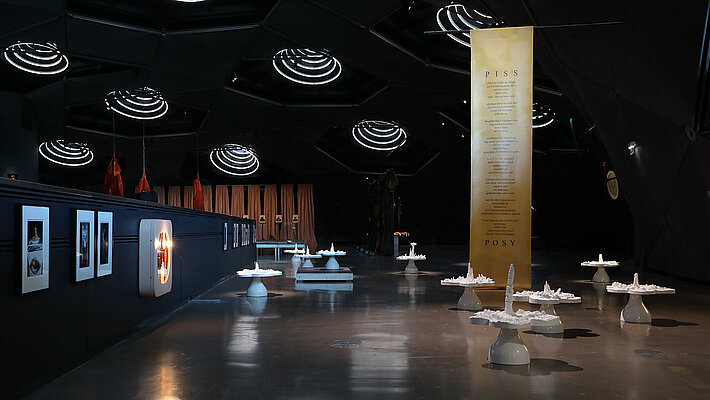
The exhibition at Space01 is dedicated to the pioneering British artist Helen Chadwick, Photo: Kunsthaus Graz/J.J. Kucek © Bildrecht Vienna, 2026
|
|
|
|
|
|
|
|
|
|
|
|
|
Liesl Raff: a thoughtful complement, a warm tribute, and a source of support
The exhibition in Graz is complemented by Liesl Raff. Her immersive installations create space for tactile experiences, shaped by a search for physical grounding and protection. As such, she serves as an ideal counterpart to the Helen Chadwick retrospective at the Kunsthaus Graz. Both artists share a fascination with living materials that create tangible atmospheres and spaces.
Raff’s interventions Dens (2024–25), Chrushes (2024–26), and Hangers (2026) span the space. Together with Sheet (Helen) (2026), a latex sheet printed using a new process that quotes Helen Chadwick’s poem “Piss Posy,” as well as Platform (Helen) (2025), minimalist spaces of experience open up. Raff’s work becomes a clever complement and a friendly homage, as well as a physically tangible support.
The works are infused with pigments, cast, and fitted with ropes or frames. They are both abstract images and sculptural structures, becoming a physical counterpart. Gravity, pressure, and states of matter become visible. Latex combines solid, liquid, and soft, and as a photosensitive material, it remains in a state of flux—part of its vitality.
Raff’s works create a dialogue between two sculptural approaches, exploring fluid states of matter as well as attraction and repulsion. Raff’s forms respond to Chadwick’s conceptual space of the hybrid and open up new ways of interpreting material, the body, and language. This dialogue, grounded in the concept of the hybrid, opens up a “third space” dedicated to the processual.
In the center of the exhibition, Raff’s works outline a podium that bears Chadwick’s silk mask on soft layers of latex. Live events and performances take place here, furthering fluid hybridizations.
|
|
|
|
|
|
|
|
|
|
|
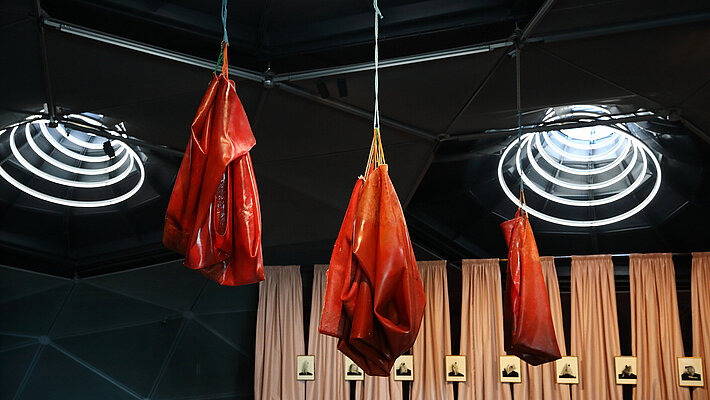
In the exhibition “Hybrid Pleasures,” Helen Chadwick’s works engage in a dialogue with latex works by the Vienna-based sculptor Liesl Raff. Photo: Kunsthaus Graz/J.J. Kucek © Bildrecht Vienna, 2026
|
|
|
_____________________________
30% Dandelion
Duration: 21.03.–08.11.2026
Curated by Katrin Bucher Trantow and Andreja Hribernik
With art work from u. a. Iris Andraschek, Suzanne Anker, Karl Blossfeldt, Andrea Bowers, Viltė Bražiūnaitė & Tomas Sinkevičius, Claude Cahun, Regula Dettwiler, Spencer Finch, Barbara Frischmuth, Anita Fuchs, Yevhen Holubentsev, Sanja Iveković, Anna Jermolaewa, Markus Jeschaunig, Claudia Larcher, Jonas Mekas, Joiri Minaya, Ryts Monet, Alois Neuhold, Agnieszka Polska, Anna Ridler, Ugo Rondinone, Martha Rosler, Sonya Schönberger, Nina Schuiki, Elfie Semotan, Petr Štembera, Alexander Stern, Thomas Stimm, Michael Stusser, Neja Tomšič, Dirck van Rijswijk, Anna Zemánková.
Hybrid Pleasures. Helen Chadwick Supported by Liesl Raff
Duration: 21.03.–20.09.2026
Curated by Laura Smith and Katrin Bucher Trantow
In collaboration with the Hepworth Wakefield Foundation (UK) and the Museum Novecento in Florence (Italy)
Kunsthaus Graz
Lendkai 1, 8020 Graz
Austria
www.kunsthausgraz.at
You can download images of the artworks and exhibition views for both exhibitions here: 30% DANDELION & HYBRID PLEASURES
_____________________________
We are happy to organise curator-led tours and interviews. Please do not hesitate to contact us if you have any questions.
Best regards
Daniela Teuschler
+43/664/8017-9214, daniela.teuschler@museum-joanneum.at
Stephanie Liebmann
+43/664/8017-9213, stephanie.liebmann@museum-joanneum.at
Eva Sappl
+43/699/1780-9002, eva.sappl@museum-joanneum.at
|
|
|
|
|
|
|
|